Pearson+ LogoPearson+ Logo
Ch. 51 - Population Ecology
Freeman - Biological Science 8th Edition
Freeman8th EditionBiological ScienceISBN: 9780138276263Not the one you use?Change textbook
Chapter 51, Problem 11

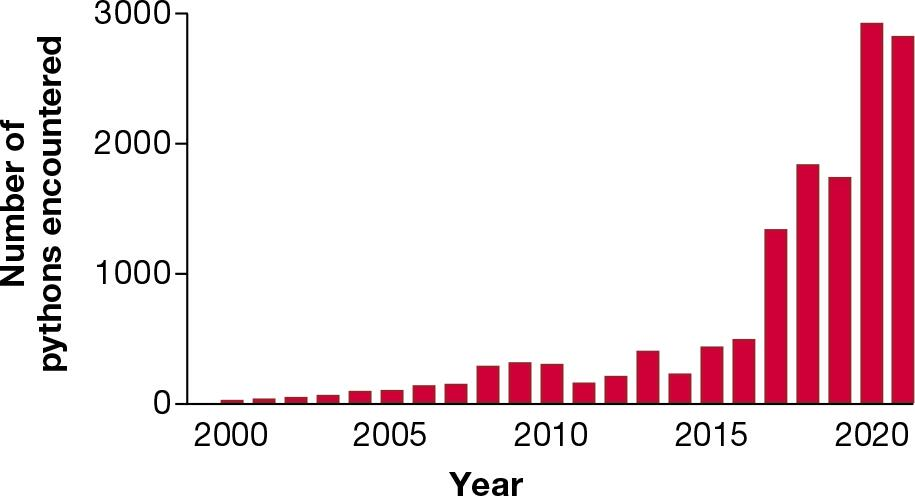
Burmese pythons (Python molurus bivittatus) are constricting snakes that can reach enormous sizes (up to 7 meters in length). They are native to Southeast Asia but were released into southern Florida from the pet trade. Many other snakes occur naturally in this area. Are the introduced pythons a problem? Burmese pythons were first found in the wetlands of Everglades National Park in the 1980s, but only rarely. The accompanying graph shows what happened next. Most of the data are derived from chance encounters of pythons on roads and intermittent search effort near roads (pythons are notoriously difficult to find). Despite the variability in search effort, what type of population growth best describes the trend in the data from 2000 to 2020? a. logistic b. exponential c. linear d. logarithmic


Verified step by step guidance
1
Examine the graph to understand the trend in the number of pythons encountered from 2000 to 2020.
Observe that the number of pythons encountered starts very low and increases slowly at first.
Notice that after a certain point, the number of pythons encountered begins to increase more rapidly.
Identify that the rapid increase in the number of pythons encountered suggests a specific type of population growth.
Compare the observed trend with the characteristics of different types of population growth (logistic, exponential, linear, logarithmic) to determine the best fit.

Verified video answer for a similar problem:

This video solution was recommended by our tutors as helpful for the problem above.
Video duration:
2m
Was this helpful?

Key Concepts

Here are the essential concepts you must grasp in order to answer the question correctly.

Population Growth Models

Population growth models describe how populations increase over time. The two primary types are exponential and logistic growth. Exponential growth occurs when resources are unlimited, leading to a rapid increase in population size. In contrast, logistic growth accounts for environmental limits, resulting in a population that grows quickly at first but slows as it approaches carrying capacity.
Recommended video:
Guided course
01:09
Introduction to Population Growth Models

Exponential Growth

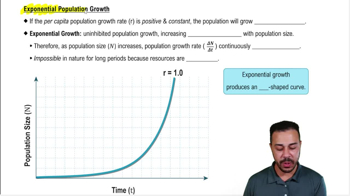
Exponential growth is characterized by a constant rate of increase, leading to a J-shaped curve when graphed. In this model, the population size doubles at regular intervals, which can lead to very large numbers in a short time. This type of growth is often seen in invasive species, like the Burmese python, when they are introduced to a new environment with few natural predators.
Recommended video:
Guided course
03:05
Exponential Population Growth

Invasive Species Impact

Invasive species, such as the Burmese python in Florida, can disrupt local ecosystems by outcompeting native species for resources, preying on them, or introducing diseases. Their rapid population growth can lead to significant ecological and economic consequences, making it crucial to monitor and manage their populations to protect native biodiversity.
Recommended video:
Guided course
03:35
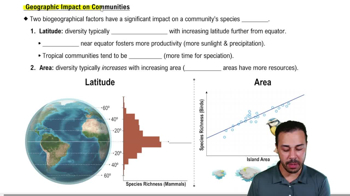
Geographic Impact on Communities
Related Practice
Textbook Question

Indicate what is correct and incorrect about this statement: If lizards want to survive during climate change, they can evolve new life-history traits.

Textbook Question

When wild plant and animal populations are logged, fished, or hunted, only the oldest or largest individuals tend to be taken. Many of the commercially important species are long lived and are slow to begin reproducing. If harvesting is not regulated carefully and exploitation is intense, what impact does harvesting have on a population's age structure? How might harvesting affect the population's life table and growth rate?

Textbook Question

<Image>

Burmese pythons (Python molurus bivittatus) are constricting snakes that can reach enormous sizes (up to 7 meters in length). They are native to Southeast Asia but were released into southern Florida from the pet trade. Many other snakes occur naturally in this area. Are the introduced pythons a problem?

Researchers hypothesize that the severe winter of 2010 caused the decline in the number of pythons encountered that year. Is cold weather typically a density-dependent factor or a density-independent factor? Explain the difference.

Textbook Question

<Image>

Burmese pythons (Python molurus bivittatus) are constricting snakes that can reach enormous sizes (up to 7 meters in length). They are native to Southeast Asia but were released into southern Florida from the pet trade. Many other snakes occur naturally in this area. Are the introduced pythons a problem?

The data in the graph show the number of pythons that were encountered, not the total number of pythons in the population. Design a mark–recapture experiment to estimate the total population size of pythons, and list at least two assumptions you would be making in your experiment.

Textbook Question

<Image>

Burmese pythons (Python molurus bivittatus) are constricting snakes that can reach enormous sizes (up to 7 meters in length). They are native to Southeast Asia but were released into southern Florida from the pet trade. Many other snakes occur naturally in this area. Are the introduced pythons a problem?

A life table would help researchers make predictions about python population growth. If you were to track a cohort of pythons over time to construct a detailed life table, what kind of data would you want to collect?