Pearson+ LogoPearson+ Logo
Ch. 51 - Population Ecology
Freeman - Biological Science 8th Edition
Freeman8th EditionBiological ScienceISBN: 9780138276263Not the one you use?Change textbook
Chapter 51, Problem 15

Burmese pythons (Python molurus bivittatus) are constricting snakes that can reach enormous sizes (up to 7 meters in length). They are native to Southeast Asia but were released into southern Florida from the pet trade. Many other snakes occur naturally in this area. Are the introduced pythons a problem? Pythons are generalist predators, consuming more than 75 species of prey including frogs, mice, rabbits, squirrels, porcupines, raccoons, leopards, deer, monkeys, alligators, and birds ranging from wrens to herons. Some surveys showed the disappearance of some animals, such as rabbits and opossums, from areas with pythons. Do you think food availability limits, or could limit, the carrying capacity of Burmese pythons in the Everglades?

Verified step by step guidance
1
Identify the concept of carrying capacity: Carrying capacity refers to the maximum number of individuals of a particular species that an environment can support sustainably without degrading the environment.
Analyze the diet of Burmese pythons: Consider the variety and abundance of prey species available in the Everglades, which include mammals, birds, and reptiles.
Evaluate the impact of pythons on prey populations: Assess whether the consumption rates by the pythons could lead to significant reductions in any of the prey populations, potentially affecting the food web and ecosystem balance.
Consider other limiting factors: Besides food availability, think about other factors that could limit the population of Burmese pythons, such as competition with other predators, diseases, and human intervention.
Hypothesize on the carrying capacity: Based on the analysis of food availability and other limiting factors, hypothesize whether food availability alone could limit the carrying capacity of Burmese pythons in the Everglades.

Verified video answer for a similar problem:

This video solution was recommended by our tutors as helpful for the problem above.
Video duration:
1m
Was this helpful?

Key Concepts

Here are the essential concepts you must grasp in order to answer the question correctly.

Carrying Capacity

Carrying capacity refers to the maximum number of individuals of a species that an environment can sustainably support, given the available resources such as food, water, and habitat. In the context of Burmese pythons in the Everglades, understanding carrying capacity is crucial to assess whether the ecosystem can support their population without leading to resource depletion or negative impacts on native species.
Recommended video:
Guided course
06:24
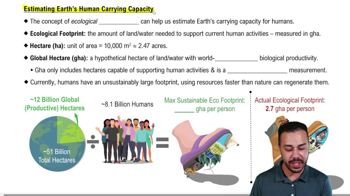
Estimating Earth’s Human Carrying Capacity

Trophic Levels and Food Webs

Trophic levels represent the hierarchical positions of organisms in an ecosystem based on their feeding relationships, from producers to various levels of consumers. Burmese pythons, as generalist predators, occupy a high trophic level, which means their predation can significantly affect the food web dynamics, potentially leading to declines in populations of prey species and altering the overall ecosystem balance.
Recommended video:
Guided course
03:14
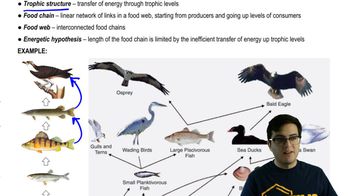
Trophic Structure

Invasive Species Impact

Invasive species are non-native organisms that, when introduced to a new environment, can disrupt local ecosystems, outcompete native species, and cause ecological and economic harm. The introduction of Burmese pythons in Florida exemplifies this issue, as their predation on a wide range of native species raises concerns about biodiversity loss and the long-term health of the Everglades ecosystem.
Recommended video:
Guided course
03:35
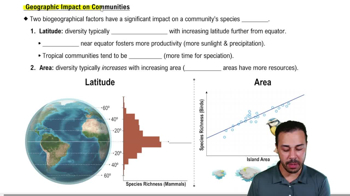
Geographic Impact on Communities
Related Practice
Textbook Question

<Image>

Burmese pythons (Python molurus bivittatus) are constricting snakes that can reach enormous sizes (up to 7 meters in length). They are native to Southeast Asia but were released into southern Florida from the pet trade. Many other snakes occur naturally in this area. Are the introduced pythons a problem?

Researchers hypothesize that the severe winter of 2010 caused the decline in the number of pythons encountered that year. Is cold weather typically a density-dependent factor or a density-independent factor? Explain the difference.

Textbook Question

<Image>

Burmese pythons (Python molurus bivittatus) are constricting snakes that can reach enormous sizes (up to 7 meters in length). They are native to Southeast Asia but were released into southern Florida from the pet trade. Many other snakes occur naturally in this area. Are the introduced pythons a problem?

The data in the graph show the number of pythons that were encountered, not the total number of pythons in the population. Design a mark–recapture experiment to estimate the total population size of pythons, and list at least two assumptions you would be making in your experiment.

Textbook Question

<Image>

Burmese pythons (Python molurus bivittatus) are constricting snakes that can reach enormous sizes (up to 7 meters in length). They are native to Southeast Asia but were released into southern Florida from the pet trade. Many other snakes occur naturally in this area. Are the introduced pythons a problem?

A life table would help researchers make predictions about python population growth. If you were to track a cohort of pythons over time to construct a detailed life table, what kind of data would you want to collect?

Textbook Question

<Image>

Burmese pythons (Python molurus bivittatus) are constricting snakes that can reach enormous sizes (up to 7 meters in length). They are native to Southeast Asia but were released into southern Florida from the pet trade. Many other snakes occur naturally in this area. Are the introduced pythons a problem?

The range of Burmese pythons in Florida is expanding rapidly. List at least one abiotic factor and one biotic factor that might limit the range of pythons.