

Pearson+ LogoPearson+ Logo
Ch. 48 - The Immune System in Animals
Freeman - Biological Science 8th Edition
Freeman8th EditionBiological ScienceISBN: 9780138276263Not the one you use?Change textbook
Chapter 48, Problem 10

Propose a hypothesis to explain how self-reactive B cells are identified and eliminated during maturation.

Verified step by step guidance
1
Step 1: Understand the concept of self-reactive B cells. These are B cells that mistakenly recognize and bind to the body's own tissues (self-antigens), which can potentially lead to autoimmune diseases.
Step 2: Recognize the importance of eliminating self-reactive B cells. The immune system must prevent these cells from becoming fully functional to maintain self-tolerance and prevent damage to the body's own tissues.
Step 3: Propose a hypothesis on the mechanism of elimination. One hypothesis could be that during B cell maturation in the bone marrow, self-reactive B cells receive strong signals through their B cell receptors (BCRs) when they bind to self-antigens present in the bone marrow.
Step 4: Consider the role of apoptosis in the elimination process. The hypothesis can include that these strong signals lead to the activation of apoptotic pathways, resulting in the programmed cell death of self-reactive B cells, thus preventing their maturation and entry into the peripheral immune system.
Step 5: Suggest a role for regulatory mechanisms. Another aspect of the hypothesis could be that certain regulatory cells or mechanisms in the bone marrow help to identify and induce apoptosis in self-reactive B cells, enhancing the selectivity of this elimination process.

Verified video answer for a similar problem:

This video solution was recommended by our tutors as helpful for the problem above.
Video duration:
3m
Was this helpful?

Key Concepts

Here are the essential concepts you must grasp in order to answer the question correctly.

B Cell Maturation

B cell maturation occurs in the bone marrow, where precursor cells develop into functional B cells. During this process, B cells undergo several stages, including heavy and light chain rearrangement, which allows them to produce unique antibodies. Proper maturation is crucial for ensuring that B cells can effectively recognize and respond to pathogens while avoiding self-reactivity.
Recommended video:
Guided course
04:06
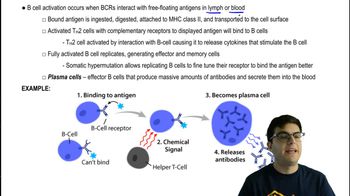
Helper T Cells and B Cells

Negative Selection

Negative selection is a critical process during B cell maturation that eliminates self-reactive B cells. This occurs when immature B cells that bind strongly to self-antigens are induced to undergo apoptosis or are rendered anergic. This mechanism is essential for maintaining self-tolerance and preventing autoimmune diseases, as it ensures that only B cells capable of recognizing foreign antigens survive.
Recommended video:
Guided course
02:41
Negative Feedback

Central Tolerance

Central tolerance refers to the processes that occur in primary lymphoid organs, such as the bone marrow, to prevent the development of autoimmunity. In the context of B cells, central tolerance involves the elimination of self-reactive clones through negative selection. This concept is fundamental in understanding how the immune system distinguishes between self and non-self, thereby protecting the body from potential autoimmune responses.
Recommended video:
Guided course
05:45
Central Dogma