Pearson+ LogoPearson+ Logo
Ch. 36 - Plant Nutrition
Freeman - Biological Science 8th Edition
Freeman8th EditionBiological ScienceISBN: 9780138276263Not the one you use?Change textbook
Chapter 36, Problem 8

Why is it important for plants to exclude certain ions?
Summarize the difference between active and passive exclusion mechanisms.

Verified step by step guidance
1
Plants need to exclude certain ions to maintain homeostasis and prevent toxicity. Some ions can be harmful in high concentrations, affecting cellular processes and overall plant health.
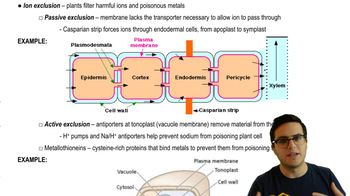
Active exclusion involves energy-dependent processes where plants use transport proteins to pump unwanted ions out of cells or into vacuoles. This requires ATP and is a selective process.
Passive exclusion relies on physical barriers or selective permeability of cell membranes. It does not require energy and involves preventing ions from entering cells through selective ion channels or transporters.
Active exclusion is more precise and can work against concentration gradients, while passive exclusion is based on the natural properties of membranes and concentration gradients.
Understanding these mechanisms helps in agricultural practices, allowing for the development of crops that can better manage ion uptake and resist soil toxicity.

Verified video answer for a similar problem:

This video solution was recommended by our tutors as helpful for the problem above.
Video duration:
41s
Was this helpful?

Key Concepts

Here are the essential concepts you must grasp in order to answer the question correctly.

Ion Exclusion in Plants

Ion exclusion is crucial for plants to maintain homeostasis and prevent toxicity. Certain ions, like sodium and heavy metals, can disrupt cellular processes if accumulated excessively. Plants have evolved mechanisms to exclude these ions, ensuring optimal growth and survival in various environments.
Recommended video:
Guided course
04:51
Ion Exclusion

Active Exclusion Mechanisms

Active exclusion involves energy-dependent processes where plants use transport proteins and pumps to move unwanted ions out of cells or into vacuoles. This mechanism requires ATP and allows plants to selectively control ion concentrations, even against a concentration gradient, ensuring cellular health and function.
Recommended video:
Guided course
04:51
Ion Exclusion

Passive Exclusion Mechanisms

Passive exclusion relies on physical barriers and selective permeability of cell membranes to prevent ions from entering cells. This mechanism does not require energy and is based on the properties of the membrane and ion channels, allowing only certain ions to pass through while excluding others based on size or charge.
Recommended video:
Guided course
04:51
Ion Exclusion
Related Practice
Textbook Question

Suppose that certain root cells have an overall charge that is more negative than normal. What impact would this likely have on the uptake of anions such as NO3⁻?

a. Anions would be less likely to enter roots.

b. Anions would be more likely to enter roots.

c. This would have no impact on the ability of anions to enter roots.

d. This would make anions and cations equally likely to enter roots.

Textbook Question

In a semester-long experiment tracking growth in plants, your lab partner—who often skips class—carefully records the mass of water added to a potted plant with the expectation that this addition will be fully accounted for in the mass gained by the plant. Is your lab partner right or wrong? Explain.

Textbook Question

Your friend claims that all plants are autotrophs because they perform photosynthesis. Is that a correct statement? Explain.

Textbook Question

There is a conflict between van Helmont's data on willow tree growth and the data on essential nutrients listed in Table 36.1. According to the table, nutrients other than C, H, and O should make up about 4 percent of a willow tree's mass. Most or all of these nutrients should come from soil. But van Helmont claimed that the soil in his experiment lost just 60 g, while the tree gained 74,000 g. Calculate the percentage of the added mass accounted for by soil, and compare it to the predicted 4 percent. State at least one hypothesis to explain the conflict between expected and observed results. How would you test this hypothesis?

Textbook Question

Design an experiment, using radioactive carbon and the heavy isotope of nitrogen (15N2), that would test whether the Rhizobia–pea plant interaction is mutualistic.

Textbook Question

The carnivorous plant Nepenthes bicalcarata ('fanged pitcher plant') has a unique relationship with a species of ant—Camponotus schmitzi ('diving ant'). The diving ants are not digested by the pitcher plants, but instead live on the plants and consume nectar. Diving ants also dive into the digestive juices in the pitcher, swim to the bottom, and capture and consume trapped insects, leaving uneaten body parts and ant feces behind. What nutritional impact do the ants have on fanged pitcher plants? Do the pitcher plants derive any nutritional benefit from this relationship? Based only on the information provided here, make a prediction on the effect of diving ants on overall pitcher plant growth.