Pearson+ LogoPearson+ Logo
Ch. 36 - Plant Nutrition
Freeman - Biological Science 8th Edition
Freeman8th EditionBiological ScienceISBN: 9780138276263Not the one you use?Change textbook
Chapter 36, Problem 6

In a semester-long experiment tracking growth in plants, your lab partner—who often skips class—carefully records the mass of water added to a potted plant with the expectation that this addition will be fully accounted for in the mass gained by the plant. Is your lab partner right or wrong? Explain.

Verified step by step guidance
1
Step 1: Understand the question. The question is asking whether the mass of water added to a plant will be fully accounted for in the mass gained by the plant.
Step 2: Recall the concept of photosynthesis. Photosynthesis is the process by which green plants and some other organisms use sunlight to synthesize foods with the help of chlorophyll pigments. In this process, plants convert carbon dioxide and water into glucose and oxygen. The chemical equation for photosynthesis is: 6CO2 + 6H2O + light energy = C6H12O6 + 6O2.
Step 3: Apply the concept of photosynthesis to the question. The water added to the plant is used in the photosynthesis process to produce glucose and oxygen. However, not all the water added to the plant is used in photosynthesis. Some of it is lost through transpiration, a process where water is lost from the plant to the atmosphere.
Step 4: Conclude the answer. Your lab partner is wrong. The mass of water added to the plant will not be fully accounted for in the mass gained by the plant because some of the water is lost through transpiration.
Step 5: Explain the importance of understanding this concept. Understanding the process of photosynthesis and transpiration is crucial in biology as it helps us understand how plants grow and survive, and how they contribute to the carbon and water cycles in nature.

Verified video answer for a similar problem:

This video solution was recommended by our tutors as helpful for the problem above.
Video duration:
1m
Was this helpful?

Key Concepts

Here are the essential concepts you must grasp in order to answer the question correctly.

Photosynthesis

Photosynthesis is the process by which green plants, algae, and some bacteria convert light energy into chemical energy, using carbon dioxide and water to produce glucose and oxygen. This process is essential for plant growth, as it provides the energy and organic compounds necessary for cellular functions and biomass accumulation.
Recommended video:
Guided course
05:58
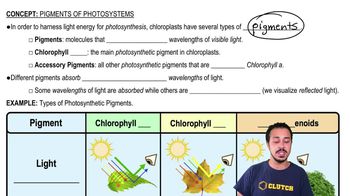
Pigments of Photosynthesis

Water's Role in Plant Growth

Water is crucial for plant growth as it serves multiple functions, including acting as a solvent for nutrients, participating in photosynthesis, and maintaining turgor pressure for structural support. However, not all water added to a plant contributes directly to its mass, as some is lost through transpiration and not all is converted into biomass.
Recommended video:
Guided course
06:53
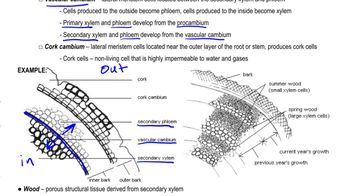
Secondary Growth

Mass Balance in Plant Growth

Mass balance in plant growth refers to the relationship between the mass of inputs (like water and nutrients) and the mass of outputs (like biomass and waste). While your lab partner expects the mass of water added to equal the mass gained by the plant, this is an oversimplification, as factors like water loss and metabolic processes affect the actual mass increase.
Recommended video:
Guided course
06:53
Secondary Growth
Related Practice
Textbook Question

Why are proton pumps in root-hair plasma membranes important?

a. They pump protons into cells, generating a membrane potential (voltage).

b. They allow toxins to be concentrated in vacuoles, so the toxins do not poison enzymes in the cytoplasm.

c. They set up an electrochemical gradient that makes it possible for roots to absorb cations and anions.

d. They set up the membrane voltage required for action potentials to occur.

Textbook Question

Why is the presence of clay particles important in soil?

a. They provide macronutrients—particularly nitrogen, phosphorus, and potassium.

b. They bind metal ions, which would be toxic if absorbed by plants.

c. They allow water to percolate through the soil, making oxygen-rich air pockets available. d. The negative charges on clay bind to positively charged ions and prevent them from being leached out of the soil.

Textbook Question

Suppose that certain root cells have an overall charge that is more negative than normal. What impact would this likely have on the uptake of anions such as NO3⁻?

a. Anions would be less likely to enter roots.

b. Anions would be more likely to enter roots.

c. This would have no impact on the ability of anions to enter roots.

d. This would make anions and cations equally likely to enter roots.

Textbook Question

Your friend claims that all plants are autotrophs because they perform photosynthesis. Is that a correct statement? Explain.

Textbook Question

Why is it important for plants to exclude certain ions?

Summarize the difference between active and passive exclusion mechanisms.

Textbook Question

There is a conflict between van Helmont's data on willow tree growth and the data on essential nutrients listed in Table 36.1. According to the table, nutrients other than C, H, and O should make up about 4 percent of a willow tree's mass. Most or all of these nutrients should come from soil. But van Helmont claimed that the soil in his experiment lost just 60 g, while the tree gained 74,000 g. Calculate the percentage of the added mass accounted for by soil, and compare it to the predicted 4 percent. State at least one hypothesis to explain the conflict between expected and observed results. How would you test this hypothesis?