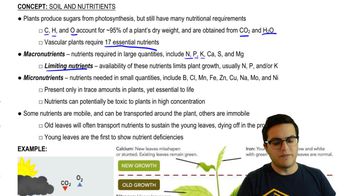
In a semester-long experiment tracking growth in plants, your lab partner—who often skips class—carefully records the mass of water added to a potted plant with the expectation that this addition will be fully accounted for in the mass gained by the plant. Is your lab partner right or wrong? Explain.
There is a conflict between van Helmont's data on willow tree growth and the data on essential nutrients listed in Table 36.1. According to the table, nutrients other than C, H, and O should make up about 4 percent of a willow tree's mass. Most or all of these nutrients should come from soil. But van Helmont claimed that the soil in his experiment lost just 60 g, while the tree gained 74,000 g. Calculate the percentage of the added mass accounted for by soil, and compare it to the predicted 4 percent. State at least one hypothesis to explain the conflict between expected and observed results. How would you test this hypothesis?

Verified step by step guidance
Verified video answer for a similar problem:
Key Concepts
Photosynthesis and Plant Growth
Essential Nutrients in Plants
Experimental Design and Hypothesis Testing
Your friend claims that all plants are autotrophs because they perform photosynthesis. Is that a correct statement? Explain.
Why is it important for plants to exclude certain ions?
Summarize the difference between active and passive exclusion mechanisms.
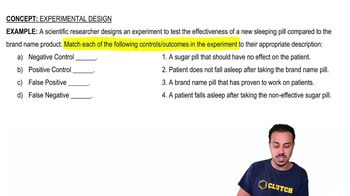
Design an experiment, using radioactive carbon and the heavy isotope of nitrogen (15N2), that would test whether the Rhizobia–pea plant interaction is mutualistic.
The carnivorous plant Nepenthes bicalcarata ('fanged pitcher plant') has a unique relationship with a species of ant—Camponotus schmitzi ('diving ant'). The diving ants are not digested by the pitcher plants, but instead live on the plants and consume nectar. Diving ants also dive into the digestive juices in the pitcher, swim to the bottom, and capture and consume trapped insects, leaving uneaten body parts and ant feces behind. What nutritional impact do the ants have on fanged pitcher plants? Do the pitcher plants derive any nutritional benefit from this relationship? Based only on the information provided here, make a prediction on the effect of diving ants on overall pitcher plant growth.
The carnivorous plant Nepenthes bicalcarata ('fanged pitcher plant') has a unique relationship with a species of ant—Camponotus schmitzi ('diving ant'). The diving ants are not digested by the pitcher plants, but instead live on the plants and consume nectar. Diving ants also dive into the digestive juices in the pitcher, swim to the bottom, and capture and consume trapped insects, leaving uneaten body parts and ant feces behind.
What nutritional impact do the ants have on fanged pitcher plants?
Do the pitcher plants derive any nutritional benefit from this relationship?
Nitrogen is a key nutrient often obtained by carnivorous plants from the insects they digest. Are the results presented here what would be expected if nitrogen is a limiting nutrient? Explain.
