Pearson+ LogoPearson+ Logo
Ch. 34 - Plant Form and Function
Freeman - Biological Science 8th Edition
Freeman8th EditionBiological ScienceISBN: 9780138276263Not the one you use?Change textbook
Chapter 34, Problem 9

Identify the structure you are consuming when you eat each of the following: Asparagus, Brussels sprouts, celery, spinach, carrots, and potatoes.

Verified step by step guidance
1
When you eat asparagus, you are consuming the stem of the plant. The stem is responsible for supporting the plant and transporting nutrients and water.
Brussels sprouts are the buds of the plant. These are small, compact, and leafy structures that grow along the stem.
Celery is primarily the petiole, which is the stalk that attaches the leaf blade to the stem. It is crunchy and fibrous.
Spinach consists of the leaves of the plant. Leaves are the primary site of photosynthesis and are rich in nutrients.
Carrots are the root of the plant. Specifically, they are taproots, which store nutrients and energy for the plant.
Potatoes are tubers, which are a type of modified stem. Tubers store starch and nutrients underground for the plant.

Verified video answer for a similar problem:

This video solution was recommended by our tutors as helpful for the problem above.
Video duration:
1m
Was this helpful?

Key Concepts

Here are the essential concepts you must grasp in order to answer the question correctly.

Plant Anatomy

Plant anatomy involves understanding the different parts of a plant, such as roots, stems, leaves, and flowers. Each part has distinct functions and structures, which are crucial for identifying what part of the plant is being consumed. For example, asparagus is primarily the stem, while spinach is the leaf.
Recommended video:
Guided course
08:18
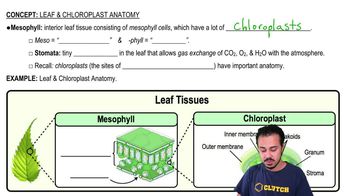
Leaf & Chloroplast Anatomy

Vegetative Structures

Vegetative structures refer to the non-reproductive parts of a plant, including roots, stems, and leaves. These structures are often consumed as vegetables. For instance, celery is a stem, carrot is a root, and potato is a tuber, which is a modified stem used for storage.
Recommended video:
Guided course
02:07
Community Structure

Botanical Classification

Botanical classification helps categorize plants based on their structural features and functions. Understanding this classification aids in identifying the edible parts of plants. Brussels sprouts are buds, which are compact clusters of immature leaves, while asparagus is a young shoot or stem.
Recommended video:
Guided course
07:21
Reviewing the Environmental Factors of Microbial Growth
Related Practice
Textbook Question

Explain why continuous growth enhances the phenomenon known as phenotypic plasticity.

Textbook Question

What does the cuticle do?

What do stomata do?

Predict how the thickness of the cuticle and the number of stomata differ in plants from wet habitats versus dry habitats.

Textbook Question

You attached a birdfeeder to a tree 5 years ago at a position 6 feet above the ground. The tree has grown since at a rate of 1 foot per year. What is the current height of the birdfeeder?

Textbook Question

Trees can be killed by girdling—the removal of bark and vascular cambium in a ring all the way around the tree. Explain why.

Textbook Question

Plants experience a vast array of conditions that can alter their growth and development, including temperature and availability of water, nutrients, and light. They are also exposed to pollutants such as acid rain formed largely as a result of burning fossil fuels and volcanic eruptions. Acid rain can strip minerals and nutrients from the soil and eat away the outer waxy layer of tissue that protects a plant. Acid rain is still a major environmental problem in certain regions.

How does acid rain affect plant growth?

Develop a hypothesis on the likely effects of acid rain on primary growth in trees.

Based on your hypothesis, make some predictions about the impact of acid rain on the height of tree trunks.

Textbook Question

Plants experience a vast array of conditions that can alter their growth and development, including temperature and availability of water, nutrients, and light. They are also exposed to pollutants such as acid rain formed largely as a result of burning fossil fuels and volcanic eruptions. Acid rain can strip minerals and nutrients from the soil, and eat away the outer waxy layer of tissue that protects a plant. Acid rain is still a major environmental problem in certain regions. How does acid rain affect plant growth? Researchers tested the effects of acid rain (pH 2.0) on seedlings of two different species, camphor tree (Cinnamomum camphora) and chinaberry tree (Melia azederach), using distilled water as a control. Results of the experiments are shown here. Note that acid rain caused a significant reduction of growth in chinaberry trees (*** means P < 0.001), but not in camphor trees. What was the approximate percentage of growth reduction observed in the chinaberry trees treated with acid rain?