Pearson+ LogoPearson+ Logo
Ch. 34 - Plant Form and Function
Freeman - Biological Science 8th Edition
Freeman8th EditionBiological ScienceISBN: 9780138276263Not the one you use?Change textbook
Chapter 34, Problem 5

Describe the general function of the shoot and the general function of the root system. Which tissues are continuous throughout these two systems?
Suggest a hypothesis to explain why the shoot and root systems of different species are so variable in size and shape.

Verified step by step guidance
1
The shoot system primarily functions in photosynthesis, reproduction, and storage. It includes structures such as stems, leaves, and flowers, which are involved in capturing light energy, gas exchange, and producing seeds.
The root system primarily functions in anchoring the plant, absorbing water and nutrients from the soil, and storing food. Roots can also interact with soil microorganisms to enhance nutrient uptake.
The vascular tissues, xylem and phloem, are continuous throughout both the shoot and root systems. Xylem transports water and minerals from roots to shoots, while phloem distributes sugars and other organic nutrients throughout the plant.
A hypothesis to explain the variability in size and shape of shoot and root systems among different species could be that these variations are adaptations to specific environmental conditions. For example, plants in arid environments may have extensive root systems to maximize water absorption, while those in dense forests may have taller shoots to compete for sunlight.
To test this hypothesis, one could compare the shoot and root system structures of plants from different environments and analyze how these structures correlate with environmental factors such as light availability, soil type, and water availability.

Verified video answer for a similar problem:

This video solution was recommended by our tutors as helpful for the problem above.
Video duration:
1m
Was this helpful?

Key Concepts

Here are the essential concepts you must grasp in order to answer the question correctly.

Function of the Shoot System

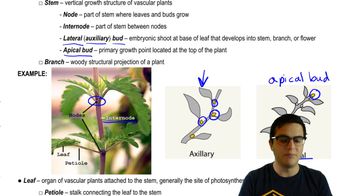
The shoot system of a plant primarily consists of stems, leaves, and flowers. Its main functions include photosynthesis, reproduction, and the transport of water and nutrients. The shoot system is responsible for capturing light energy and converting it into chemical energy through photosynthesis, as well as facilitating gas exchange and supporting reproductive structures.
Recommended video:
Guided course
05:46
Shoots and Leaves

Function of the Root System

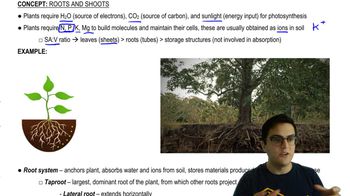
The root system anchors the plant in the soil and is crucial for water and nutrient absorption. It stores food and nutrients, and in some plants, it can also be involved in vegetative reproduction. Roots play a vital role in interacting with soil microorganisms, which can enhance nutrient uptake and provide protection against pathogens.
Recommended video:

Continuous Tissues in Plant Systems

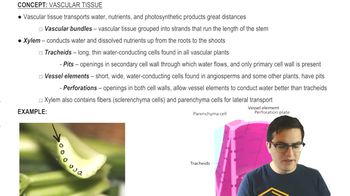
Vascular tissues, specifically xylem and phloem, are continuous throughout the shoot and root systems. Xylem transports water and dissolved minerals from the roots to the rest of the plant, while phloem distributes the sugars and nutrients produced by photosynthesis. This continuity allows for efficient resource distribution and communication between different parts of the plant.
Recommended video:
Guided course
06:58
Vascular Tissue
Related Practice
Textbook Question

Evaluate the following statements regarding tracheids and vessel elements.

Select True or False for each statement.

T/F Both tracheids and vessel elements are specialized for water conduction.

T/F Both tracheids and vessel elements have pits.

T/F Vessel elements have perforation plates but tracheids do not.

T/F Tracheids and vessel elements have to be alive in order to transport water.

Textbook Question

Which statement best characterizes primary growth?

a. It does not occur in roots, only in shoots.

b. It leads to the development of cork tissue.

c. It produces the dermal, ground, and vascular tissues.

d. It produces rings of xylem, phloem, and cork tissue.

Textbook Question

Which statement best characterizes secondary growth?

a. It results from cell divisions in the vascular and cork cambia.

b. It increases the length of the plant stem.

c. It results from divisions in the apical meristem cells.

d. It often produces phloem cells to the inside and xylem cells to the outside of the vascular cambium.

Textbook Question

Explain why continuous growth enhances the phenomenon known as phenotypic plasticity.

Textbook Question

What does the cuticle do?

What do stomata do?

Predict how the thickness of the cuticle and the number of stomata differ in plants from wet habitats versus dry habitats.

Textbook Question

You attached a birdfeeder to a tree 5 years ago at a position 6 feet above the ground. The tree has grown since at a rate of 1 foot per year. What is the current height of the birdfeeder?