Pearson+ LogoPearson+ Logo
Ch. 34 - Plant Form and Function
Freeman - Biological Science 8th Edition
Freeman8th EditionBiological ScienceISBN: 9780138276263Not the one you use?Change textbook
Chapter 34, Problem 2

Evaluate the following statements regarding tracheids and vessel elements.
Select True or False for each statement.
T/F Both tracheids and vessel elements are specialized for water conduction.
T/F Both tracheids and vessel elements have pits.
T/F Vessel elements have perforation plates but tracheids do not.
T/F Tracheids and vessel elements have to be alive in order to transport water.

Verified step by step guidance
1
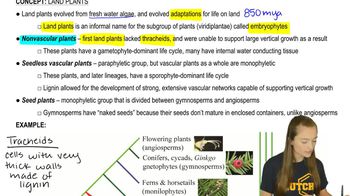
Understand that tracheids and vessel elements are both types of cells found in the xylem, which is responsible for water conduction in plants.
Recognize that both tracheids and vessel elements have pits, which are small openings that allow water to move between cells.
Learn that vessel elements have perforation plates, which are openings at the ends of the cells that allow for more efficient water flow, while tracheids do not have these plates.
Note that tracheids and vessel elements are dead at maturity, meaning they do not need to be alive to transport water. Their cell walls remain intact to facilitate water movement.
Evaluate each statement based on the information provided: 1) Both tracheids and vessel elements are specialized for water conduction. 2) Both have pits. 3) Vessel elements have perforation plates, tracheids do not. 4) They do not need to be alive to transport water.

Verified video answer for a similar problem:

This video solution was recommended by our tutors as helpful for the problem above.
Video duration:
1m
Was this helpful?

Key Concepts

Here are the essential concepts you must grasp in order to answer the question correctly.

Water Conduction in Plants

Water conduction in plants is primarily facilitated by xylem tissue, which includes tracheids and vessel elements. These structures are specialized for transporting water and minerals from roots to other parts of the plant. Tracheids are elongated cells that overlap, while vessel elements are shorter and form continuous tubes, both contributing to efficient water movement.
Recommended video:

Pits in Xylem Cells

Pits are small openings in the cell walls of xylem cells, including both tracheids and vessel elements. They allow for lateral movement of water between adjacent cells, facilitating efficient water transport throughout the plant. Pits are crucial for maintaining connectivity and flexibility in the plant's vascular system, especially under varying environmental conditions.
Recommended video:
Guided course
07:59
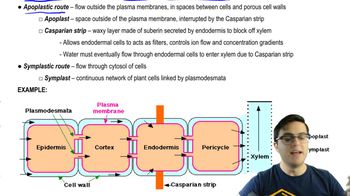
How Water Enters Xylem

Perforation Plates

Perforation plates are structures found in vessel elements that allow for direct flow of water between cells. Unlike tracheids, which lack these plates, vessel elements have perforations that reduce resistance and enhance water conduction efficiency. This structural difference is key to understanding the distinct roles and functionalities of tracheids and vessel elements in the xylem.
Recommended video:
Guided course
04:33
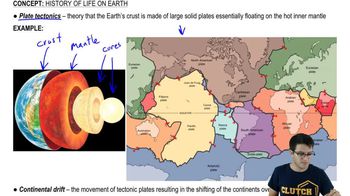
Plate Tectonics and Continental Drift