Pearson+ LogoPearson+ Logo
Ch. 30 - An Introduction to Animals
Freeman - Biological Science 8th Edition
Freeman8th EditionBiological ScienceISBN: 9780138276263Not the one you use?Change textbook
Chapter 30, Problem 11

The vast majority of animals that ever existed are now extinct, but Tereza Jezkova and John Wiens wondered which variables were most important in driving the diversification of species that exist today.
Why are there so many species in some phyla, such as Cnidaria (see photo), but so few in others, such as Ctenophora?
Draw a horizontal axis to represent the number of species within phyla using a logarithmic scale (1, 10, 100, 1000 species, etc.). Then use Table 30.1 to map seven representative phyla from small to large at intervals of about an order of magnitude on this scale.

Verified step by step guidance
1
Step 1: Understand the problem. The goal is to represent the number of species within seven phyla on a logarithmic scale. A logarithmic scale is useful for visualizing data that spans several orders of magnitude, as it compresses large values while preserving their relative differences.
Step 2: Analyze the provided graph. The graph shows the number of species identified for seven phyla: Sponges, Mollusks, Flatworms, Jellyfish (Cnidaria), Chordates, Roundworms, and Arthropods. Note the approximate number of species for each phylum from the graph.
Step 3: Convert the species counts into logarithmic values. For example, if a phylum has 10,000 species, its logarithmic value is log10(10,000) = 4. Repeat this for all phyla using their respective species counts.
Step 4: Draw a horizontal axis labeled 'Number of Species (Log Scale)' with intervals such as 1, 10, 100, 1000, and 10,000. Place each phylum on the axis based on its logarithmic value. For example, Sponges might fall closer to 1, while Arthropods might fall closer to 10,000.
Step 5: Map the seven phyla on the axis at intervals of about an order of magnitude. Ensure the placement reflects the relative differences in species counts as shown in the graph. For example, Arthropods will be farthest to the right, while Sponges will be farthest to the left.

Verified video answer for a similar problem:

This video solution was recommended by our tutors as helpful for the problem above.
Video duration:
49s
Was this helpful?

Key Concepts

Here are the essential concepts you must grasp in order to answer the question correctly.

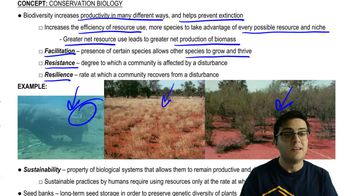
Biodiversity

Biodiversity refers to the variety of life forms within a given ecosystem, biome, or on the entire planet. It encompasses the diversity of species, genetic variations, and the ecosystems they inhabit. High biodiversity often indicates a healthy ecosystem, while low biodiversity can signal environmental stress or degradation. Understanding biodiversity is crucial for studying species distribution and the factors influencing their survival and evolution.
Recommended video:
Guided course
05:06
Biodiversity and Sustainability

Phylogenetic Relationships

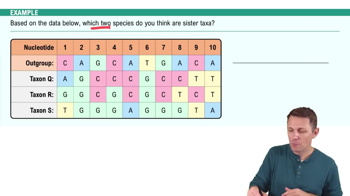
Phylogenetic relationships illustrate the evolutionary connections between different species or groups of organisms. These relationships are often depicted in phylogenetic trees, which show how species diverged from common ancestors over time. Analyzing these relationships helps scientists understand the evolutionary history of species, including why certain phyla, like Cnidaria, have more species than others, such as Ctenophora.
Recommended video:
04:13
Building Phylogenetic Trees Example 2

Ecological Niches

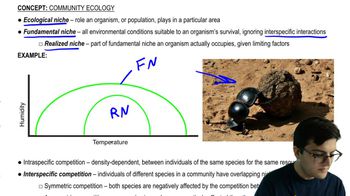
An ecological niche describes the role and position a species has in its environment, including its habitat, resource use, and interactions with other organisms. Different species occupy different niches, which can lead to varying levels of species richness within phyla. Factors such as competition, predation, and environmental conditions influence how many species can coexist in a given niche, contributing to the observed diversity among different phyla.
Recommended video:
Guided course
02:48
Ecological Niches and Competition