Pearson+ LogoPearson+ Logo
Ch. 30 - An Introduction to Animals
Freeman - Biological Science 8th Edition
Freeman8th EditionBiological ScienceISBN: 9780138276263Not the one you use?Change textbook
Chapter 30, Problem 9

Suppose that a gene originally identified in nematodes (roundworms) is found to be homologous with a gene that can cause developmental abnormalities in humans. Would it be possible to use fruit flies as a model organism to study this gene? Explain.

Verified step by step guidance
1
Understand the concept of homologous genes: Homologous genes are genes that share a common ancestry and often have similar sequences and functions across different species. This means that studying a homologous gene in one organism can provide insights into its function in another organism.
Recognize the importance of model organisms: Fruit flies (Drosophila melanogaster) are widely used as model organisms in biological research due to their genetic similarity to humans, short life cycle, ease of genetic manipulation, and well-characterized genome.
Consider the evolutionary conservation of genes: If the gene in question is homologous between nematodes and humans, it is likely conserved across other species, including fruit flies. This conservation suggests that fruit flies may possess a similar version of the gene, making them suitable for study.
Evaluate the experimental advantages of fruit flies: Fruit flies allow researchers to perform genetic experiments, such as gene knockouts, overexpression studies, and mutational analyses, to investigate the gene's role in development and its potential link to abnormalities.
Conclude the feasibility of using fruit flies: Based on the evolutionary conservation of homologous genes and the experimental tools available for fruit flies, it would be possible and scientifically valuable to use fruit flies as a model organism to study the gene and its effects on development.

Verified video answer for a similar problem:

This video solution was recommended by our tutors as helpful for the problem above.
Video duration:
2m
Was this helpful?

Key Concepts

Here are the essential concepts you must grasp in order to answer the question correctly.

Homologous Genes

Homologous genes are genes that share a common ancestry, meaning they have evolved from a common ancestral gene. This similarity can be observed in their DNA sequences and functions across different species. Studying homologous genes allows researchers to understand evolutionary relationships and the conservation of biological functions, which is crucial when investigating gene functions in model organisms.
Recommended video:
Guided course
08:09
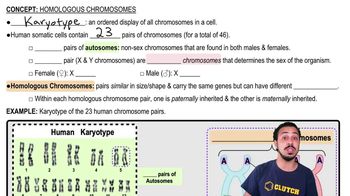
Homologous Chromosomes

Model Organisms

Model organisms are non-human species that are extensively studied to understand biological processes, genetics, and disease mechanisms. Common examples include fruit flies (Drosophila melanogaster), mice, and zebrafish. These organisms are chosen for their genetic tractability, short life cycles, and the ability to produce large numbers of offspring, making them ideal for experimental research and insights applicable to other species, including humans.
Recommended video:
Guided course
01:09
Introduction to Population Growth Models

Developmental Biology

Developmental biology is the study of the processes by which organisms grow and develop, focusing on the genetic, cellular, and molecular mechanisms that guide these processes. Understanding developmental biology is essential when investigating genes that cause abnormalities, as it provides insights into how specific genes influence development and how disruptions can lead to malformations or diseases in organisms, including humans.
Recommended video: