Pearson+ LogoPearson+ Logo
Ch. 30 - An Introduction to Animals
Freeman - Biological Science 8th Edition
Freeman8th EditionBiological ScienceISBN: 9780138276263Not the one you use?Change textbook
Chapter 30, Problem 7

Evaluate this statement: Animals evolved from simple to complex.

Verified step by step guidance
1
Step 1: Understand the statement. The statement is saying that animals evolved from simple forms to more complex forms. This is a common understanding of evolution, but it's important to note that 'simple' and 'complex' are relative terms.
Step 2: Consider the evidence. The fossil record shows that the earliest life forms were much simpler than most organisms alive today. Over time, new traits and structures have evolved, leading to a greater diversity and complexity of life.
Step 3: Consider the process of evolution. Evolution is driven by natural selection, where traits that improve an organism's chances of survival and reproduction are more likely to be passed on to the next generation. Over time, this can lead to the development of new traits and greater complexity.
Step 4: Consider exceptions. While it's generally true that life has become more complex over time, this is not a hard and fast rule. Some organisms have actually become simpler over time, losing traits that they no longer need. This is known as 'regressive evolution'.
Step 5: Formulate a response. Based on the evidence and understanding of evolution, it can be said that the statement is generally true, but with some exceptions. Evolution often leads to greater complexity, but not always.

Verified video answer for a similar problem:

This video solution was recommended by our tutors as helpful for the problem above.
Video duration:
1m
Was this helpful?

Key Concepts

Here are the essential concepts you must grasp in order to answer the question correctly.

Evolution

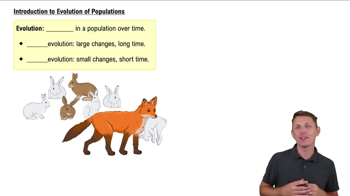
Evolution is the process through which species change over time through mechanisms such as natural selection, genetic drift, and mutation. It explains how simple organisms can give rise to more complex forms through gradual adaptations to their environments. Understanding evolution is crucial for evaluating claims about the progression from simple to complex life forms.
Recommended video:
05:14
Introduction to Evolution of Populations

Phylogeny

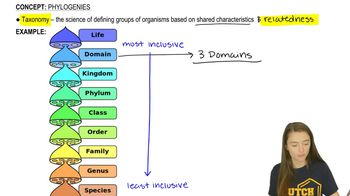
Phylogeny refers to the evolutionary history and relationships among species. It is often represented in a phylogenetic tree, which illustrates how different species are related through common ancestors. This concept helps in understanding the complexity of animal evolution and the branching patterns that lead to diverse forms of life.
Recommended video:
Guided course
09:32
Taxonomy and Phylogeny

Complexity in Biology

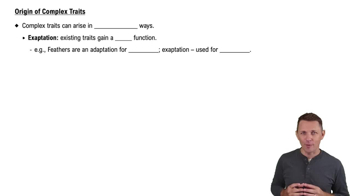
Complexity in biology often refers to the structural and functional intricacies of organisms. While some may interpret evolution as a linear progression from simple to complex, it is more accurate to view it as a branching process where complexity can arise in various forms, including multicellularity, specialization of cells, and behavioral adaptations. This understanding challenges the notion of a straightforward evolutionary ladder.
Recommended video:
06:15
Origin of Complex Traits
Related Practice
Textbook Question

Which of these characteristics does not apply to cnidarians?

a. Are diploblastic

b. Possess a gastrovascular cavity with one opening

c. Undergo metamorphosis

d. Have a central nervous system

Textbook Question

Why is it ecologically significant that animals are heterotrophic and multicellular?

Textbook Question

To estimate the relative abundance of the major phyla, calculate how many named species of arthropods, mollusks, and nematode worms exist per named species of chordate (the phylum containing vertebrates, including humans; see Table 30.1).

Do you think these calculations are likely to be underestimates or overestimates? Why?

Textbook Question

Suppose that a gene originally identified in nematodes (roundworms) is found to be homologous with a gene that can cause developmental abnormalities in humans. Would it be possible to use fruit flies as a model organism to study this gene? Explain.

Textbook Question

The vast majority of animals that ever existed are now extinct, but Tereza Jezkova and John Wiens wondered which variables were most important in driving the diversification of species that exist today.

Why are there so many species in some phyla, such as Cnidaria (see photo), but so few in others, such as Ctenophora?

Draw a horizontal axis to represent the number of species within phyla using a logarithmic scale (1, 10, 100, 1000 species, etc.). Then use Table 30.1 to map seven representative phyla from small to large at intervals of about an order of magnitude on this scale.