Pearson+ LogoPearson+ Logo
Ch. 29 - Fungi
Freeman - Biological Science 8th Edition
Freeman8th EditionBiological ScienceISBN: 9780138276263Not the one you use?Change textbook
Chapter 29, Problem 1

Which statement about the daughter cells following mitosis and cytokinesis is correct? a. They are genetically different from each other and from the parent cell. b. They are genetically identical to each other and to the parent cell. c. They are genetically identical to each other but different from the parent cell. d. Only one of the two daughter cells is genetically identical to the parent cell.

Verified step by step guidance
1
Understand the process of mitosis: Mitosis is a type of cell division where a single cell divides to produce two new daughter cells that are genetically identical to each other and to the original parent cell.
Review the genetic outcome of mitosis: The purpose of mitosis is to distribute identical sets of chromosomes to each of the two daughter cells. This ensures that both cells have the same genetic information as the parent cell.
Analyze the answer choices in relation to the mitosis process: Option (a) suggests genetic differences among all cells, which contradicts the purpose of mitosis. Option (d) suggests that only one daughter cell is identical to the parent, which is incorrect as both should be identical.
Consider the implications of cytokinesis: Cytokinesis is the process that follows mitosis, where the cell's cytoplasm divides, creating two separate cells. This process does not alter the genetic makeup, which remains identical to the parent cell.
Conclude with the correct answer: Based on the understanding of mitosis and cytokinesis, the correct answer is (b) - 'They are genetically identical to each other and to the parent cell.' This reflects the fundamental outcome of mitosis where the genetic material is equally and identically distributed to each daughter cell.

Verified video answer for a similar problem:

This video solution was recommended by our tutors as helpful for the problem above.
Video duration:
2m
Was this helpful?

Key Concepts

Here are the essential concepts you must grasp in order to answer the question correctly.

Mitosis

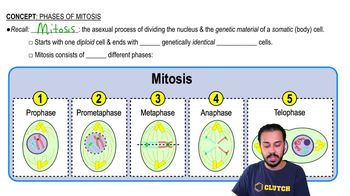
Mitosis is the process of cell division that results in two genetically identical daughter cells from a single parent cell. It involves several stages: prophase, metaphase, anaphase, and telophase, where the chromosomes are duplicated and evenly distributed. This ensures that each daughter cell receives an exact copy of the parent cell's genetic material.
Recommended video:
Guided course
03:21
Phases of Mitosis

Cytokinesis

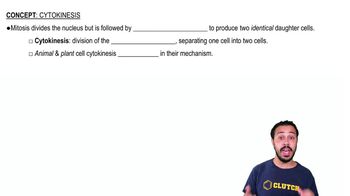
Cytokinesis is the final step of cell division, occurring after mitosis, where the cytoplasm of the parent cell divides, resulting in two separate daughter cells. In animal cells, this process involves the formation of a cleavage furrow that pinches the cell into two. In plant cells, a cell plate forms to create a new cell wall between the daughter cells.
Recommended video:

Genetic Identity

Genetic identity refers to the genetic similarity between cells. In the context of mitosis, the daughter cells are genetically identical to each other and to the parent cell, as they contain the same DNA. This is crucial for maintaining genetic consistency across cell generations, which is essential for growth, repair, and asexual reproduction.
Recommended video: