

Ch. 29 - Fungi
Freeman - Biological Science 8th Edition
Freeman8th EditionBiological ScienceISBN: 9780138276263Not the one you use?Change textbook
Chapter 29, Problem 1

The mycelial growth habit leads to a body with a high surface-area-to-volume ratio. Why is this important? a. Mycelia have a large surface area for absorption. b. The hyphae that make up mycelia are long, thin tubes. c. Most hyphae are broken up into compartments by walls called septa, although some exist as single, gigantic cells. d. Hyphae can infiltrate living or dead tissues.

Verified step by step guidance
1
Step 1: Understand the question. The question is asking why it is important for the mycelial growth habit to have a high surface-area-to-volume ratio.
Step 2: Review the options. Option a suggests that a large surface area is important for absorption. Option b describes the physical structure of hyphae, which are the building blocks of mycelia. Option c provides information about the internal structure of most hyphae. Option d explains that hyphae can infiltrate living or dead tissues.
Step 3: Apply your knowledge of biology. In biology, a high surface-area-to-volume ratio is often beneficial for absorption. This is because the larger the surface area, the more space there is for substances to be absorbed.
Step 4: Make a connection between the information given and your knowledge. Mycelia, being composed of hyphae, would have a large surface area due to the long, thin structure of the hyphae. This large surface area would allow for efficient absorption of nutrients from the environment.
Step 5: Choose the correct answer. Based on the information and reasoning above, the correct answer is option a: Mycelia have a large surface area for absorption.

Verified video answer for a similar problem:

This video solution was recommended by our tutors as helpful for the problem above.
Video duration:
2m
Was this helpful?

Key Concepts

Here are the essential concepts you must grasp in order to answer the question correctly.

Surface Area-to-Volume Ratio

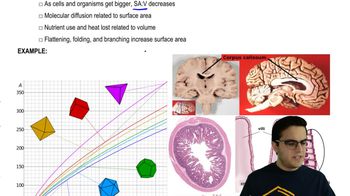
The surface area-to-volume ratio is a critical concept in biology that describes how the surface area of an organism or structure compares to its volume. A high ratio allows for more efficient exchange of materials, such as nutrients and gases, with the environment. In the context of mycelial growth, this ratio enhances the ability of fungi to absorb nutrients from their surroundings, which is vital for their survival and growth.
Recommended video:
Guided course
07:47
Surface Area to Volume Ratio

Mycelium Structure

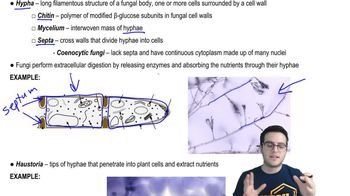
Mycelium is the vegetative part of fungi, consisting of a network of thread-like structures called hyphae. These hyphae are typically long and thin, which contributes to a greater surface area for absorption. The structure of mycelium allows fungi to efficiently explore and exploit their environment, making them effective decomposers and nutrient recyclers in ecosystems.
Recommended video:
Guided course
04:25
Community Structure

Septa in Hyphae

Septa are cross-walls that divide the hyphae of some fungi into compartments. This structural feature can enhance the efficiency of nutrient transport and provide structural integrity to the mycelium. While some fungi have septate hyphae, others have coenocytic hyphae, which lack septa and allow for a continuous flow of cytoplasm, facilitating rapid growth and resource distribution.
Recommended video: