
Pearson+ LogoPearson+ Logo
Ch. 29 - Fungi
Freeman - Biological Science 8th Edition
Freeman8th EditionBiological ScienceISBN: 9780138276263Not the one you use?Change textbook
Chapter 29, Problem 2

Evaluate the following statements about mushrooms. Select True or False for each statement.
T/F A diploid zygote is formed when a male spore fertilizes a female spore.
T/F Haploid spores are formed by meiosis in basidia.
T/F A mushroom is a reproductive structure that consists largely of dikaryotic cells.
T/F Mushrooms are part of the group that also includes bracket fungi, boletes, puffballs, and stinkhorns.

Verified step by step guidance
1
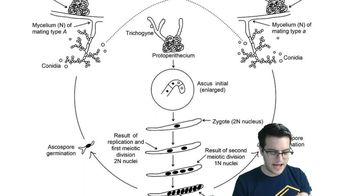
Understand the life cycle of mushrooms: Mushrooms are part of the fungi kingdom, and their life cycle includes both sexual and asexual reproduction. The sexual reproduction involves the formation of a diploid zygote, but it occurs through the fusion of two haploid nuclei, not male and female spores.
Examine the process of spore formation: In basidiomycetes, which include mushrooms, haploid spores are formed through meiosis in specialized cells called basidia. This process is crucial for sexual reproduction and genetic diversity.
Explore the cellular structure of mushrooms: Mushrooms are primarily composed of dikaryotic cells, which means they have two separate nuclei per cell. This is a characteristic feature of the reproductive structure of basidiomycetes.
Identify the classification of mushrooms: Mushrooms belong to the phylum Basidiomycota, which includes other fungi such as bracket fungi, boletes, puffballs, and stinkhorns. These groups share similar reproductive structures and life cycles.
Review each statement based on the above information: Use the understanding of mushroom biology to evaluate the truthfulness of each statement regarding the formation of zygotes, spore production, cellular structure, and classification.

Verified video answer for a similar problem:

This video solution was recommended by our tutors as helpful for the problem above.
Video duration:
47s
Was this helpful?

Key Concepts

Here are the essential concepts you must grasp in order to answer the question correctly.

Fungal Reproduction

Fungal reproduction often involves complex life cycles with both sexual and asexual phases. In many fungi, including mushrooms, sexual reproduction involves the fusion of haploid spores to form a diploid zygote, which then undergoes meiosis to produce haploid spores. Understanding these processes is crucial for evaluating statements about fungal reproduction.
Recommended video:
Guided course
03:12
Fungi Reproduction - 3

Basidia and Meiosis

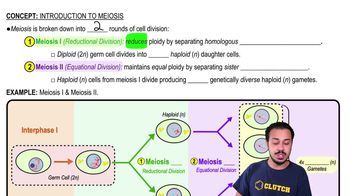
Basidia are specialized structures found in mushrooms where meiosis occurs, leading to the formation of haploid spores. These spores are crucial for the dispersal and propagation of fungi. Recognizing the role of basidia in spore formation helps in understanding the reproductive strategies of mushrooms and related fungi.
Recommended video:
Guided course
04:49
Meiosis I & Meiosis II

Dikaryotic Cells in Mushrooms

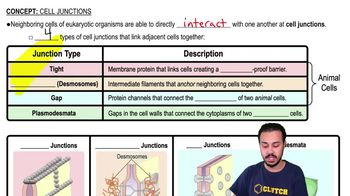
Mushrooms are primarily composed of dikaryotic cells, which contain two genetically distinct nuclei per cell. This stage precedes the formation of a diploid zygote and is a characteristic feature of many fungi, including mushrooms. Understanding the dikaryotic phase is essential for grasping the structure and function of mushrooms as reproductive entities.
Recommended video:
Guided course
05:33
Cell Junctions
Related Practice
Textbook Question

Which statement about the daughter cells following mitosis and cytokinesis is correct? a. They are genetically different from each other and from the parent cell. b. They are genetically identical to each other and to the parent cell. c. They are genetically identical to each other but different from the parent cell. d. Only one of the two daughter cells is genetically identical to the parent cell.

1
views
Textbook Question

The mycelial growth habit leads to a body with a high surface-area-to-volume ratio. Why is this important? a. Mycelia have a large surface area for absorption. b. The hyphae that make up mycelia are long, thin tubes. c. Most hyphae are broken up into compartments by walls called septa, although some exist as single, gigantic cells. d. Hyphae can infiltrate living or dead tissues.

1
views
Textbook Question

The hyphae of arbuscular mycorrhizal fungi (AMF) form bushy structures after making contact with the plasma membrane of a root cell. What is the function of these structures?

a. They anchor the fungus inside the root, so the association is more permanent.

b. They increase the surface area available for the transfer of nutrients.

c. They produce toxins that protect the plant cells against herbivores.

d. They break down cellulose and lignin in the plant cell wall.

Textbook Question

What does it mean to say that a hypha is dikaryotic?

a. Two nuclei fuse during sexual reproduction to form a zygote.

b. Two independent nuclei, derived from different individuals, are present in each cell.

c. The nucleus is diploid or polyploid — not haploid.

d. It is extremely highly branched, which increases its surface area and thus absorptive capacity.

1
views
Textbook Question

The Greek root ecto means 'outer.' Why are ectomycorrhizal fungi, or EMF, aptly named?

a. Their hyphae form tree-like branching structures inside plant cell walls.

b. They are mutualistic.

c. Their hyphae form dense mats that envelop roots but do not penetrate the cell walls.

d. They transfer nitrogen from outside their plant hosts to the interior.

1
views