Pearson+ LogoPearson+ Logo
Ch. 17 - Transcription, RNA Processing, and Translation
Freeman - Biological Science 8th Edition
Freeman8th EditionBiological ScienceISBN: 9780138276263Not the one you use?Change textbook
Chapter 17, Problem 8

In what ways are a promoter and a start codon similar? In what ways are they different?

Verified step by step guidance
1
Understand the definitions: A promoter is a DNA sequence that signals the start of transcription, where RNA polymerase binds to initiate RNA synthesis. A start codon, on the other hand, is an mRNA sequence (typically AUG) that signals the start of translation, where the ribosome begins assembling a protein.
Identify the similarity: Both the promoter and the start codon are involved in initiating key processes in gene expression. The promoter initiates transcription (DNA to RNA), while the start codon initiates translation (RNA to protein).
Examine the differences in function: The promoter is a regulatory sequence in DNA that controls when and where transcription occurs. The start codon is a coding sequence in mRNA that specifies the first amino acid in a protein (usually methionine in eukaryotes).
Consider the molecular machinery involved: The promoter interacts with RNA polymerase and transcription factors, while the start codon interacts with the ribosome and tRNA carrying methionine.
Summarize the distinction: The promoter is part of the DNA and functions at the transcriptional level, while the start codon is part of the mRNA and functions at the translational level. They are similar in their role as initiation signals but differ in their molecular context and specific processes.

Verified video answer for a similar problem:

This video solution was recommended by our tutors as helpful for the problem above.
Video duration:
1m
Was this helpful?

Key Concepts

Here are the essential concepts you must grasp in order to answer the question correctly.

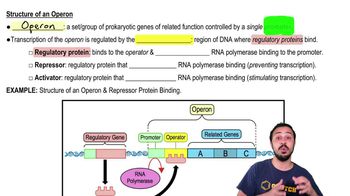
Promoter

A promoter is a specific DNA sequence located upstream of a gene that serves as a binding site for RNA polymerase and transcription factors. It initiates the transcription of the gene into messenger RNA (mRNA). Promoters are crucial for regulating gene expression, as they determine when and how much of a gene is transcribed.
Recommended video:
Guided course
04:23
Structure of an Operon

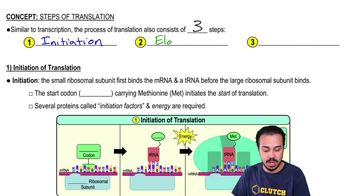
Start Codon

A start codon is a specific sequence of three nucleotides (AUG) in mRNA that signals the beginning of translation. It is recognized by the ribosome, which assembles amino acids into a polypeptide chain. The start codon is essential for protein synthesis, as it establishes the reading frame for the ribosome to translate the mRNA into a functional protein.
Recommended video:
Guided course
05:03
1) Initiation of Translation

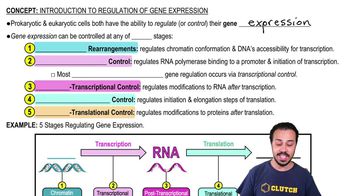
Gene Expression Regulation

Gene expression regulation refers to the mechanisms that control the timing and amount of gene expression. Both promoters and start codons play roles in this process: promoters regulate the transcription of genes, while start codons mark the beginning of translation. Understanding these elements is vital for comprehending how genes are turned on or off in response to various cellular signals.
Recommended video:
Guided course
06:40
Introduction to Regulation of Gene Expression
Related Practice
Textbook Question

RNases and proteases are enzymes that destroy RNAs and proteins, respectively. Which of the following enzymes, if added to a spliceosome, would be predicted to prevent recognition of pre-mRNA regions critical for splicing?

a. An RNase specific for tRNAs

b. An RNase specific for snRNAs

c. A protease specific for initiation factors

d. A protease specific for a release factor

Textbook Question

For each of these statements about the genetic code, select True or False.

a. T/F Wobble pairing accounts for the redundancy of the genetic code.

b. T/F There are 64 different tRNAs that read the 64 possible codons.

c. T/F All possible codons are used, but not all codons specify an amino acid.

d. T/F Some codons are recognized by proteins, not by tRNAs.

Textbook Question

In a particular bacterial species, temperature-sensitive conditional mutations cause expression of a wild-type phenotype at one growth temperature and a mutant phenotype at another—typically higher—temperature. Imagine that when a bacterial cell carrying such a mutation is shifted from low to high growth temperatures, RNA polymerases in the process of elongation complete transcription normally, but no new transcripts can be started. The mutation in this strain most likely affects:

a. The terminator sequence

b. The start codon

c. Sigma

d. One of the polypeptides of the core RNA polymerase

Textbook Question

The nucleotide shown here is called cordycepin triphosphate. It is a natural product of a fungus that is used in traditional medicines.

If cordycepin triphosphate is added to a cell-free transcription reaction, the nucleotide is added onto the growing RNA chain but then no more nucleotides can be added. Examine the structure of cordycepin and explain why it ends transcription.

3
views
Textbook Question

Controlling the rates of transcription and translation is important in bacteria to avoid collisions between ribosomes and RNA polymerases. Calculate what the maximum rate of translation by a ribosome in a bacterial cell would have to be, in units of amino acids per second, so as not to overtake an RNA polymerase that is synthesizing mRNA at a rate of 60 nucleotides per second. How long would it take for this bacterial cell to translate an mRNA containing 1800 codons?

Textbook Question

<Image>

Eating even a single death cap mushroom (Amanita phalloides) can be fatal due to a compound called α-amanitin, a toxin that inhibits transcription.

What would you predict to be the immediate outcome of adding α-amanitin to a cell?

a. Reduced DNA synthesis

b. Reduced production of one or more types of RNA

c. Reduced binding of tRNAs to anticodons

d. Reduced rate of translocation of ribosomes translating mRNA