Pearson+ LogoPearson+ Logo
Ch. 17 - Transcription, RNA Processing, and Translation
Freeman - Biological Science 8th Edition
Freeman8th EditionBiological ScienceISBN: 9780138276263Not the one you use?Change textbook
Chapter 17, Problem 10

Controlling the rates of transcription and translation is important in bacteria to avoid collisions between ribosomes and RNA polymerases. Calculate what the maximum rate of translation by a ribosome in a bacterial cell would have to be, in units of amino acids per second, so as not to overtake an RNA polymerase that is synthesizing mRNA at a rate of 60 nucleotides per second. How long would it take for this bacterial cell to translate an mRNA containing 1800 codons?

Verified step by step guidance
1
Step 1: Understand the relationship between nucleotides, codons, and amino acids. Each codon is composed of 3 nucleotides, and each codon corresponds to one amino acid during translation. Therefore, the rate of transcription (60 nucleotides per second) can be converted into codons per second by dividing by 3.
Step 2: Calculate the maximum rate of translation by a ribosome. To avoid collisions, the ribosome must translate at a rate equal to or less than the rate at which codons are produced during transcription. Use the rate of transcription (in codons per second) as the upper limit for the ribosome's translation rate.
Step 3: Determine the time required to translate an mRNA containing 1800 codons. Translation occurs at the rate determined in Step 2, and the total time can be calculated using the formula: \( \text{Time} = \frac{\text{Total codons}}{\text{Translation rate}} \).
Step 4: Substitute the values into the formula. Use 1800 codons for the total codons and the translation rate calculated in Step 2 to find the time required for translation.
Step 5: Ensure the units are consistent throughout the calculation. Verify that the rate of translation is in amino acids per second and the time is in seconds. This ensures the final result is accurate and meaningful.

Verified video answer for a similar problem:

This video solution was recommended by our tutors as helpful for the problem above.
Video duration:
1m
Was this helpful?

Key Concepts

Here are the essential concepts you must grasp in order to answer the question correctly.

Transcription and Translation

Transcription is the process by which RNA polymerase synthesizes mRNA from a DNA template, while translation is the process where ribosomes synthesize proteins by decoding mRNA into amino acids. In bacteria, these processes are tightly coordinated to ensure efficient protein synthesis and to prevent collisions between the ribosomes and RNA polymerases.
Recommended video:
Guided course
04:07
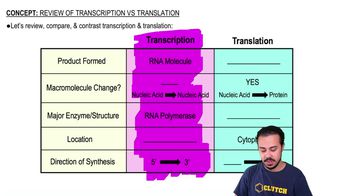
Review of Transcription vs. Translation

Codons and Amino Acids

Codons are sequences of three nucleotides in mRNA that correspond to specific amino acids during translation. Since there are 1800 codons in the given mRNA, this means that 1800 amino acids will be synthesized, with each codon directing the addition of one amino acid to the growing polypeptide chain.
Recommended video:

Rate of Synthesis

The rate of synthesis refers to how quickly transcription and translation occur. In this scenario, RNA polymerase synthesizes mRNA at 60 nucleotides per second, which translates to 20 codons per second (since each codon consists of three nucleotides). To avoid collisions, the ribosome's translation rate must not exceed this rate, ensuring that it can keep pace with mRNA synthesis.
Recommended video:
Guided course
07:08
Metabolic Rate
Related Practice
Textbook Question

In a particular bacterial species, temperature-sensitive conditional mutations cause expression of a wild-type phenotype at one growth temperature and a mutant phenotype at another—typically higher—temperature. Imagine that when a bacterial cell carrying such a mutation is shifted from low to high growth temperatures, RNA polymerases in the process of elongation complete transcription normally, but no new transcripts can be started. The mutation in this strain most likely affects:

a. The terminator sequence

b. The start codon

c. Sigma

d. One of the polypeptides of the core RNA polymerase

Textbook Question

In what ways are a promoter and a start codon similar? In what ways are they different?

1
views
Textbook Question

The nucleotide shown here is called cordycepin triphosphate. It is a natural product of a fungus that is used in traditional medicines.

If cordycepin triphosphate is added to a cell-free transcription reaction, the nucleotide is added onto the growing RNA chain but then no more nucleotides can be added. Examine the structure of cordycepin and explain why it ends transcription.

3
views
Textbook Question

<Image>

Eating even a single death cap mushroom (Amanita phalloides) can be fatal due to a compound called α-amanitin, a toxin that inhibits transcription.

What would you predict to be the immediate outcome of adding α-amanitin to a cell?

a. Reduced DNA synthesis

b. Reduced production of one or more types of RNA

c. Reduced binding of tRNAs to anticodons

d. Reduced rate of translocation of ribosomes translating mRNA

Textbook Question

<Image>

Eating even a single death cap mushroom (Amanita phalloides) can be fatal due to a compound called α-amanitin, a toxin that inhibits transcription.

α-Amanitin inhibits transcription by binding inside an RNA polymerase to a region other than the active site that catalyzes addition of a nucleotide to the RNA chain. Based on the model of RNA polymerase shown in Figure 17.3, predict how the toxin might function to inhibit transcription.

3
views
Textbook Question

<Image>

Eating even a single death cap mushroom (Amanita phalloides) can be fatal due to a compound called α-amanitin, a toxin that inhibits transcription.

Toxins like α-amanitin are used for research in much the same way as null mutants (Chapter 16)—to disrupt a process and see what happens when it no longer works. Researchers examined the ability of α-amanitin to inhibit different RNA polymerases. They purified RNA polymerases I, II, and III from rat liver, incubated the enzymes with different concentrations of α-amanitin, and then tested their activity. The results of this experiment are shown here. These findings suggest that cells treated with α-amanitin will have a reduced level of:

a. tRNAs

b. rRNAs

c. snRNAs

d. mRNAs