Pearson+ LogoPearson+ Logo
Ch. 16 - How Genes Work
Freeman - Biological Science 8th Edition
Freeman8th EditionBiological ScienceISBN: 9780138276263Not the one you use?Change textbook
Chapter 16, Problem 10

One of the possibilities considered about the genetic code was that the code was overlapping, meaning that a single base could be part of up to three codons. How many amino acids would be encoded in the sequence 5′-AUGUUACGGAAU-3′ by a non-overlapping and a maximally overlapping triplet code?
a. 4 (non-overlapping) and 16 (overlapping)
b. 4 and 12
c. 4 and 10
d. 12 and 4

Verified step by step guidance
1
Step 1: Understand the concept of a codon. A codon is a sequence of three nucleotides (bases) in mRNA that corresponds to a specific amino acid during translation. In a non-overlapping code, each codon is read sequentially in groups of three without sharing bases.
Step 2: Analyze the non-overlapping code. In the sequence 5′-AUGUUACGGAAU-3′, divide the sequence into groups of three bases starting from the first base. This results in the codons AUG, UUA, CGG, and AAU. Count the number of codons to determine how many amino acids are encoded.
Step 3: Understand the concept of a maximally overlapping code. In an overlapping code, each base can be part of multiple codons. For example, starting from the first base, the codons would be AUG, UGU, GUU, UUA, UAC, ACG, CGG, GGA, GAA, and AAU. Each codon shifts by one base, maximizing the overlap.
Step 4: Analyze the overlapping code. Count the number of codons generated by shifting one base at a time through the sequence. Each codon corresponds to a potential amino acid encoded.
Step 5: Compare the results. The non-overlapping code produces fewer codons (and thus fewer amino acids) compared to the maximally overlapping code. Use the counts from Steps 2 and 4 to determine the correct answer choice.

Verified video answer for a similar problem:

This video solution was recommended by our tutors as helpful for the problem above.
Video duration:
1m
Was this helpful?

Key Concepts

Here are the essential concepts you must grasp in order to answer the question correctly.

Genetic Code

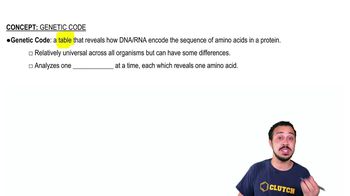
The genetic code is a set of rules that defines how sequences of nucleotides in DNA or RNA are translated into proteins. It consists of codons, which are triplets of nucleotides that correspond to specific amino acids. Understanding the genetic code is essential for determining how many amino acids are encoded by a given nucleotide sequence.
Recommended video:

Non-overlapping vs. Overlapping Codons

In a non-overlapping genetic code, each nucleotide is part of only one codon, meaning that codons are read sequentially without sharing nucleotides. In contrast, a maximally overlapping code allows a single nucleotide to be part of multiple codons, potentially increasing the number of amino acids encoded. This distinction is crucial for calculating the number of amino acids from a nucleotide sequence.
Recommended video:
Guided course
03:57
Resource Partitioning (Partial Niche Overlap)

Codon Reading Frame

The reading frame refers to the way nucleotides are grouped into codons during translation. For a non-overlapping code, the reading frame starts at the first nucleotide and progresses in triplets. In an overlapping code, the reading frame can shift, allowing for different combinations of codons to be formed from the same nucleotide sequence, which affects the total number of amino acids produced.
Recommended video:
04:32
Reading Trees
Related Practice
Textbook Question

Explain what's wrong with this statement: All point mutations change the genotype and the phenotype.

Textbook Question

Draw a hypothetical metabolic pathway in Neurospora crassa composed of five substrates, five enzymes, and a product called nirvana. Number the substrates 1–5, and label the enzymes A–E, in order. (For instance, enzyme A catalyzes the reaction between substrates 1 and 2.)

(a) Suppose a mutation made the gene for enzyme C nonfunctional. What molecule would accumulate in the affected cells?

Textbook Question

Draw a hypothetical metabolic pathway in Neurospora crassa composed of five substrates, five enzymes, and a product called nirvana. Number the substrates 1–5, and label the enzymes A–E, in order. (For instance, enzyme A catalyzes the reaction between substrates 1 and 2.)

(b) Suppose a mutant strain can survive if substrate 5 is added to the growth medium, but it cannot grow if substrates 1, 2, 3, or 4 are added. Which enzyme in the pathway is affected in this mutant?

1
views
Textbook Question

Skin color is often one of the first traits people notice in each other. Studies in zebrafish uncovered a mutation that altered a transport protein and resulted in light-colored fish. This discovery led to the finding that the same gene in humans has a strong influence on skin pigmentation in many populations. The zebrafish mutation that reduced coloration created a null allele of the transport protein gene. Which of the following types of mutation would be most likely to create this null allele?

a. A missense mutation

b. A frameshift mutation

c. A neutral mutation

d. A silent mutation

Textbook Question

Investigators examined the expression of transporter mRNA and protein produced in zebrafish homozygous for each of the alleles and obtained the results summarized here (+=present,−=absent). Does the allele associated with light color appear to be altering transcription ortranslation? Why?

Textbook Question

A small portion of the human transport protein amino acid sequence is shown here. The upper sequence is associated with darker skin, and the lower sequence is associated with lighter skin. What DNA base-pair change created the light-skin form of the human protein from the gene that coded for the dark-skin form?