Pearson+ LogoPearson+ Logo
Ch. 16 - How Genes Work
Freeman - Biological Science 8th Edition
Freeman8th EditionBiological ScienceISBN: 9780138276263Not the one you use?Change textbook
Chapter 16, Problem 9b

Draw a hypothetical metabolic pathway in Neurospora crassa composed of five substrates, five enzymes, and a product called nirvana. Number the substrates 1–5, and label the enzymes A–E, in order. (For instance, enzyme A catalyzes the reaction between substrates 1 and 2.)
(b) Suppose a mutant strain can survive if substrate 5 is added to the growth medium, but it cannot grow if substrates 1, 2, 3, or 4 are added. Which enzyme in the pathway is affected in this mutant?

Verified step by step guidance
1
Begin by understanding the concept of a metabolic pathway. A metabolic pathway is a series of chemical reactions occurring within a cell, where each step is facilitated by a specific enzyme. In this problem, you need to create a pathway with five substrates and five enzymes leading to a final product called nirvana.
Draw the pathway: Start with substrate 1, which is converted to substrate 2 by enzyme A. Then, substrate 2 is converted to substrate 3 by enzyme B. Continue this pattern, where substrate 3 is converted to substrate 4 by enzyme C, substrate 4 is converted to substrate 5 by enzyme D, and finally, substrate 5 is converted to the product nirvana by enzyme E.
Label each part of the pathway: Assign numbers to the substrates (1 to 5) and letters to the enzymes (A to E). Ensure that enzyme A catalyzes the reaction between substrates 1 and 2, enzyme B between substrates 2 and 3, and so on, until enzyme E catalyzes the conversion of substrate 5 to nirvana.
Analyze the mutant strain scenario: The mutant strain can survive only if substrate 5 is added, indicating that the conversion from substrate 4 to substrate 5 is not occurring naturally. This suggests that enzyme D, which catalyzes the conversion of substrate 4 to substrate 5, is affected in the mutant strain.
Conclude the analysis: Since the mutant strain cannot grow with substrates 1, 2, 3, or 4, but can grow with substrate 5, enzyme D is likely non-functional or absent in the mutant strain, preventing the conversion of substrate 4 to substrate 5.

Verified video answer for a similar problem:

This video solution was recommended by our tutors as helpful for the problem above.
Video duration:
2m
Was this helpful?

Key Concepts

Here are the essential concepts you must grasp in order to answer the question correctly.

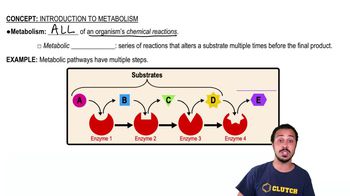
Metabolic Pathway

A metabolic pathway is a series of chemical reactions occurring within a cell, where each step is facilitated by a specific enzyme. These pathways convert substrates through intermediate steps into a final product, playing a crucial role in maintaining cellular functions and energy production.
Recommended video:
Guided course
02:17
Introduction to Metabolism

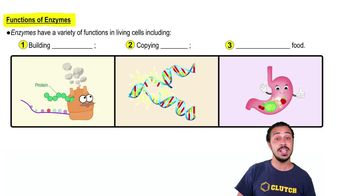
Enzyme Function

Enzymes are biological catalysts that speed up chemical reactions in metabolic pathways without being consumed. Each enzyme is specific to a particular reaction, facilitating the conversion of substrates into products. In the context of the question, enzymes A-E catalyze sequential reactions between substrates 1-5 to produce the final product, nirvana.
Recommended video:
Guided course
02:32
Functions of Enzymes

Mutant Strain Analysis

Analyzing mutant strains involves understanding how genetic mutations affect metabolic pathways. In the given scenario, the mutant strain's inability to grow with substrates 1-4 suggests a disruption in the pathway before substrate 5. This indicates that the enzyme responsible for converting substrate 4 to 5 is likely defective, preventing the completion of the pathway.
Recommended video:
Guided course
08:56
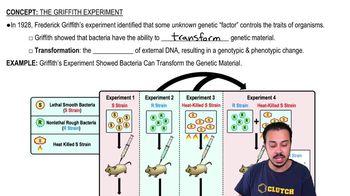
The Griffith Experiment
Related Practice
Textbook Question

Which of the following describes mutations? Select True or False for each statement.

T/F Point mutations can occur in any DNA sequence.

T/F Frameshift mutations can occur in any DNA sequence.

T/F Neutral mutations depend on the degeneracy of the genetic code.

T/F Deleterious mutations occur only in protein-coding sequences of DNA.

Textbook Question

Explain what's wrong with this statement: All point mutations change the genotype and the phenotype.

Textbook Question

Draw a hypothetical metabolic pathway in Neurospora crassa composed of five substrates, five enzymes, and a product called nirvana. Number the substrates 1–5, and label the enzymes A–E, in order. (For instance, enzyme A catalyzes the reaction between substrates 1 and 2.)

(a) Suppose a mutation made the gene for enzyme C nonfunctional. What molecule would accumulate in the affected cells?

Textbook Question

One of the possibilities considered about the genetic code was that the code was overlapping, meaning that a single base could be part of up to three codons. How many amino acids would be encoded in the sequence 5′-AUGUUACGGAAU-3′ by a non-overlapping and a maximally overlapping triplet code?

a. 4 (non-overlapping) and 16 (overlapping)

b. 4 and 12

c. 4 and 10

d. 12 and 4

Textbook Question

Skin color is often one of the first traits people notice in each other. Studies in zebrafish uncovered a mutation that altered a transport protein and resulted in light-colored fish. This discovery led to the finding that the same gene in humans has a strong influence on skin pigmentation in many populations. The zebrafish mutation that reduced coloration created a null allele of the transport protein gene. Which of the following types of mutation would be most likely to create this null allele?

a. A missense mutation

b. A frameshift mutation

c. A neutral mutation

d. A silent mutation

Textbook Question

Investigators examined the expression of transporter mRNA and protein produced in zebrafish homozygous for each of the alleles and obtained the results summarized here (+=present,−=absent). Does the allele associated with light color appear to be altering transcription ortranslation? Why?