Pearson+ LogoPearson+ Logo
Ch. 31 - Fungi
Campbell - Campbell Biology 12th Edition
Urry12th EditionCampbell BiologyISBN: 9785794169850Not the one you use?Change textbook
Chapter 31, Problem 5

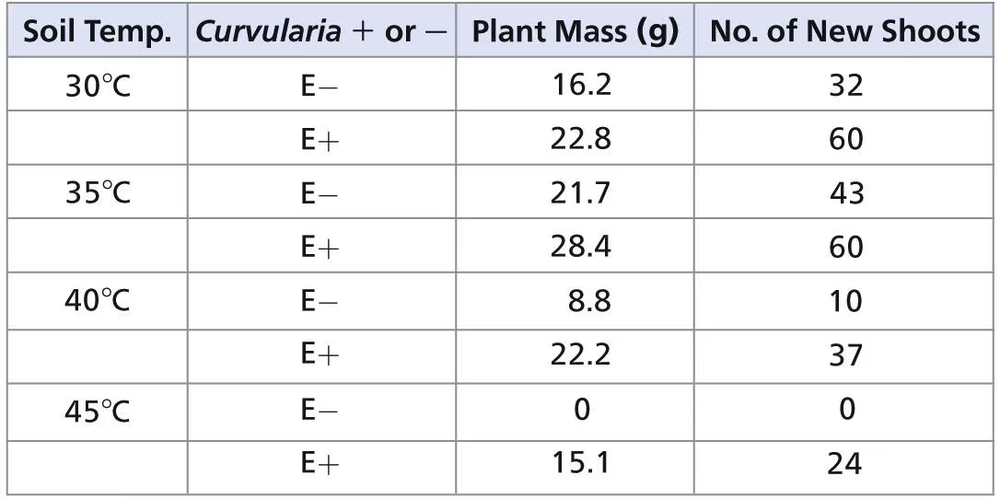
The grass Dichanthelium lanuginosum lives in hot soils and houses fungi of the genus Curvularia as endophytes. Researchers tested the impact of Curvularia on the heat tolerance of this grass. They grew plants without (E−) and with (E+) Curvularia endophytes at different temperatures and measured plant mass and the number of new shoots the plants produced. Draw a bar graph for plant mass versus temperature and interpret it.
Table showing plant mass and new shoots of grass with and without Curvularia at various soil temperatures.
Data from R. S. Redman et al., Thermotolerance generated by plant/fungal symbiosis, Science 298:1581 (2002).

Verified step by step guidance
1
Step 1: Organize the data collected from the experiment. You should have two sets of data: one for plants without Curvularia endophytes (E−) and one for plants with Curvularia endophytes (E+). Each set should include measurements of plant mass at different temperatures.
Step 2: Choose an appropriate scale for your bar graph. The x-axis will represent the different temperatures at which the plants were grown, and the y-axis will represent the plant mass. Ensure that the scale is consistent and allows for clear comparison between the E− and E+ groups.
Step 3: Plot the data on the bar graph. For each temperature, draw two bars side by side: one for the E− group and one for the E+ group. The height of each bar should correspond to the average plant mass measured at that temperature.
Step 4: Label your graph clearly. Include a title that describes the graph, such as 'Plant Mass vs. Temperature for Dichanthelium lanuginosum'. Label the axes with 'Temperature (°C)' and 'Plant Mass (g)', and include a legend to differentiate between the E− and E+ groups.
Step 5: Interpret the graph. Look for trends in the data, such as whether the presence of Curvularia endophytes (E+) increases plant mass at higher temperatures compared to plants without endophytes (E−). Discuss how these trends might indicate the role of Curvularia in enhancing heat tolerance in the grass.

Verified video answer for a similar problem:

This video solution was recommended by our tutors as helpful for the problem above.
Video duration:
1m
Was this helpful?

Key Concepts

Here are the essential concepts you must grasp in order to answer the question correctly.

Endophytes

Endophytes are microorganisms, often fungi or bacteria, that live within a plant for at least part of their life cycle without causing apparent disease. They can enhance plant growth and stress tolerance, such as heat resistance, by producing beneficial compounds or facilitating nutrient uptake. In this study, Curvularia endophytes are hypothesized to improve the heat tolerance of Dichanthelium lanuginosum.
Recommended video:

Heat Tolerance in Plants

Heat tolerance refers to a plant's ability to survive and thrive at high temperatures. It involves physiological and biochemical adaptations that protect cellular structures and maintain metabolic functions. In the context of this study, researchers are examining how the presence of Curvularia endophytes affects the grass's ability to withstand elevated temperatures, as indicated by changes in plant mass and shoot production.
Recommended video:

Scientific Data Interpretation

Interpreting scientific data involves analyzing results to draw meaningful conclusions about the research question. This includes understanding trends, comparing experimental groups, and considering variables like temperature and endophyte presence. In this case, interpreting the bar graph of plant mass versus temperature will reveal the impact of Curvularia endophytes on the heat tolerance of Dichanthelium lanuginosum.
Recommended video:
Guided course
06:29
Scientific Method