Pearson+ LogoPearson+ Logo
Ch. 4 - Body Weight and Health
Belk, Maier - Biology: Science for Life 6th Edition
Belk, Maier6th EditionBiology: Science for LifeISBN: 9780135214084Not the one you use?Change textbook
Chapter 4, Problem 9

Most of the energy in an ATP molecule is released ________.
a. During cellular respiration.
b. When the terminal phosphate group is hydrolyzed.
c. In the form of new nucleotides.
d. When it is transferred to NADH.

Verified step by step guidance
1
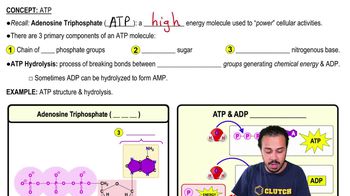
Understand the structure of an ATP (adenosine triphosphate) molecule: ATP consists of an adenine base, a ribose sugar, and three phosphate groups. The bonds between the phosphate groups are high-energy bonds, particularly the bond between the second and third phosphate groups (the terminal phosphate).
Recall the process of hydrolysis: Hydrolysis is a chemical reaction where water is used to break a bond. In the case of ATP, hydrolysis breaks the bond between the second and third phosphate groups, releasing energy.
Identify the role of the terminal phosphate group: When the terminal phosphate group is removed during hydrolysis, ATP is converted into ADP (adenosine diphosphate) and an inorganic phosphate (Pi). This reaction releases a significant amount of energy that can be used by the cell for various processes.
Eliminate incorrect options: a) Cellular respiration is the process of generating ATP, not where energy is released from ATP. c) New nucleotides are not involved in the energy release from ATP. d) NADH is a carrier molecule in cellular respiration, but it is not directly related to ATP hydrolysis.
Conclude that the correct answer is related to the hydrolysis of the terminal phosphate group, as this is the step where most of the energy in an ATP molecule is released.

Verified video answer for a similar problem:

This video solution was recommended by our tutors as helpful for the problem above.
Video duration:
57s
Was this helpful?

Key Concepts

Here are the essential concepts you must grasp in order to answer the question correctly.

ATP Structure and Function

Adenosine triphosphate (ATP) is a nucleotide composed of an adenine base, a ribose sugar, and three phosphate groups. It serves as the primary energy carrier in cells, providing energy for various biochemical processes. The energy stored in ATP is primarily found in the high-energy bonds between the phosphate groups.
Recommended video:

Hydrolysis of ATP

The hydrolysis of ATP involves the breaking of the bond between the terminal phosphate group and the rest of the molecule, resulting in adenosine diphosphate (ADP) and an inorganic phosphate (Pi). This reaction releases a significant amount of energy, which is utilized by cells for various functions, including muscle contraction and active transport.
Recommended video:

Cellular Respiration

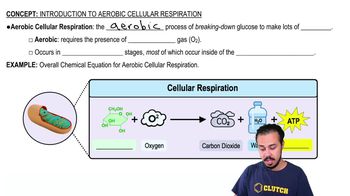
Cellular respiration is the metabolic process by which cells convert biochemical energy from nutrients into ATP, primarily through glycolysis, the Krebs cycle, and oxidative phosphorylation. While ATP is produced during this process, the question specifically focuses on the energy release during ATP hydrolysis, which is distinct from the energy generation during cellular respiration.
Recommended video:
Guided course
03:39
Introduction to Cellular Respiration