Pearson+ LogoPearson+ Logo
Ch. 4 - Body Weight and Health
Belk, Maier - Biology: Science for Life 6th Edition
Belk, Maier6th EditionBiology: Science for LifeISBN: 9780135214084Not the one you use?Change textbook
Chapter 4, Problem 7

Cellular respiration involves ________.
a. The aerobic metabolism of sugars in the mitochondria by a process called glycolysis.
b. An electron transport chain that releases carbon dioxide.
c. The synthesis of ATP, which is driven by the rushing of protons through an ATP synthase.
d. Electron carriers that bring electrons to the citric acid cycle; e. the production of water during the citric acid cycle.

Verified step by step guidance
1
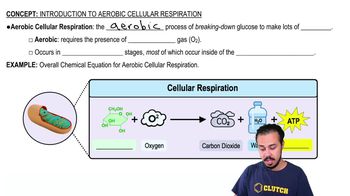
Step 1: Understand the process of cellular respiration. Cellular respiration is a metabolic pathway that converts glucose into energy in the form of ATP. It involves three main stages: glycolysis, the citric acid cycle (Krebs cycle), and the electron transport chain (ETC).
Step 2: Analyze the options provided. Each option describes a specific aspect of cellular respiration. Carefully evaluate whether the description aligns with the correct biological process.
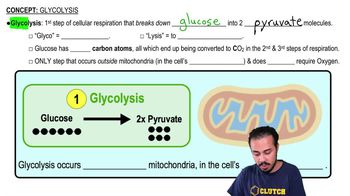
Step 3: Recall that glycolysis occurs in the cytoplasm, not the mitochondria, and it is the first step of cellular respiration. It does not require oxygen (anaerobic) and breaks down glucose into pyruvate, producing a small amount of ATP and NADH.
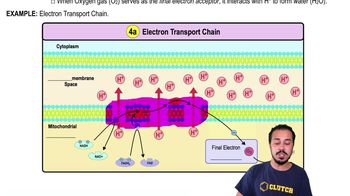
Step 4: Remember that the electron transport chain (ETC) is located in the inner mitochondrial membrane. It uses electron carriers (NADH and FADH2) to transfer electrons, creating a proton gradient that drives ATP synthesis through ATP synthase. This process also produces water as oxygen acts as the final electron acceptor.
Step 5: Evaluate the synthesis of ATP. ATP is synthesized when protons flow back into the mitochondrial matrix through ATP synthase, driven by the proton gradient created by the ETC. This is a key feature of oxidative phosphorylation, which is part of cellular respiration.

Verified video answer for a similar problem:

This video solution was recommended by our tutors as helpful for the problem above.
Video duration:
40s
Was this helpful?

Key Concepts

Here are the essential concepts you must grasp in order to answer the question correctly.

Cellular Respiration

Cellular respiration is a metabolic process that converts biochemical energy from nutrients into adenosine triphosphate (ATP), and releases waste products. It primarily occurs in the mitochondria and involves several stages, including glycolysis, the citric acid cycle, and oxidative phosphorylation. This process is essential for providing energy to cells for various functions.
Recommended video:
Guided course
03:39
Introduction to Cellular Respiration

Glycolysis

Glycolysis is the first step of cellular respiration, occurring in the cytoplasm, where glucose is broken down into pyruvate, producing a small amount of ATP and NADH. This anaerobic process does not require oxygen and serves as a precursor to aerobic respiration, leading to further energy extraction in the mitochondria.
Recommended video:

Electron Transport Chain

The electron transport chain (ETC) is a series of protein complexes located in the inner mitochondrial membrane that facilitate the transfer of electrons from electron carriers like NADH and FADH2. As electrons move through the chain, energy is released, which is used to pump protons into the intermembrane space, creating a proton gradient that drives ATP synthesis through ATP synthase.
Recommended video:
Guided course
07:41
Electron Transport Chain
Related Practice
Textbook Question

Which of the following is a false statement regarding enzymes?

a. Enzymes are proteins that speed up metabolic reactions.

b. Enzymes have specific substrates.

c. Enzymes supply ATP to their substrates.

d. An enzyme may be used many times.

2
views
Textbook Question

Enzymes speed up chemical reactions by ________.

a. Heating cells

b. Binding to substrates and placing stress on their bonds

c. Changing the shape of the cell

d. Supplying energy to the substrate

Textbook Question

What would happen if activation energy barriers didn't exist?

a. Substrates would not bind properly to enzymes.

b. Chemical reactions in the body would never occur.

c. Enzyme function would not be affected.

d. Metabolic reactions would proceed even if their products were not needed.

2
views
Textbook Question

The electron transport chain ________.

a. Is located in the matrix of the mitochondrion.

b. Has the electronegative carbon dioxide at its base.

c. Is a series of nucleotides located in the inner mitochondrial membrane.

d. Is a series of enzymes located in the intermembrane space.

e. Moves electrons from protein to protein and moves protons from the matrix into the intermembrane space.

Textbook Question

Most of the energy in an ATP molecule is released ________.

a. During cellular respiration.

b. When the terminal phosphate group is hydrolyzed.

c. In the form of new nucleotides.

d. When it is transferred to NADH.

1
views
Textbook Question

Anaerobic respiration ________.

a. Generates proteins for muscles to use.

b. Occurs in yeast cells only.

c. Does not use oxygen as the final electron acceptor.

d. Uses glycolysis, the citric acid cycle, and the electron transport chain.

1
views