Pearson+ LogoPearson+ Logo
Ch. 4 - Body Weight and Health
Belk, Maier - Biology: Science for Life 6th Edition
Belk, Maier6th EditionBiology: Science for LifeISBN: 9780135214084Not the one you use?Change textbook
Chapter 4, Problem 10

Anaerobic respiration ________.
a. Generates proteins for muscles to use.
b. Occurs in yeast cells only.
c. Does not use oxygen as the final electron acceptor.
d. Uses glycolysis, the citric acid cycle, and the electron transport chain.

Verified step by step guidance
1
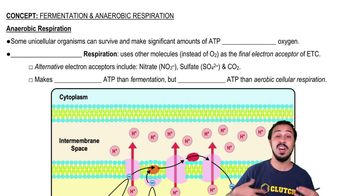
Understand the concept of anaerobic respiration: Anaerobic respiration is a type of cellular respiration that occurs without oxygen. It is used by certain organisms or cells when oxygen is unavailable or in limited supply.
Analyze the role of oxygen in cellular respiration: In aerobic respiration, oxygen acts as the final electron acceptor in the electron transport chain. In anaerobic respiration, a different molecule (e.g., sulfate, nitrate, or carbon dioxide) serves as the final electron acceptor instead of oxygen.
Evaluate the processes involved in anaerobic respiration: Anaerobic respiration typically involves glycolysis to break down glucose into pyruvate, followed by fermentation or other pathways to regenerate NAD+ for glycolysis. The citric acid cycle and electron transport chain are not typically involved in anaerobic respiration.
Consider the organisms that perform anaerobic respiration: Anaerobic respiration is not limited to yeast cells. It can occur in various organisms, including certain bacteria and muscle cells under low oxygen conditions.
Eliminate incorrect options: Based on the above analysis, identify the correct statement about anaerobic respiration. For example, it does not generate proteins, is not exclusive to yeast cells, and does not involve the full aerobic pathway (glycolysis, citric acid cycle, and electron transport chain).

Verified video answer for a similar problem:

This video solution was recommended by our tutors as helpful for the problem above.
Video duration:
53s
Was this helpful?

Key Concepts

Here are the essential concepts you must grasp in order to answer the question correctly.

Anaerobic Respiration

Anaerobic respiration is a metabolic process that occurs in the absence of oxygen. It allows organisms to generate energy by converting glucose into energy-rich molecules like ATP, using alternative electron acceptors instead of oxygen. This process is crucial for certain microorganisms and muscle cells during intense exercise when oxygen is scarce.
Recommended video:
Guided course
03:35
Anaerobic Respiration

Glycolysis

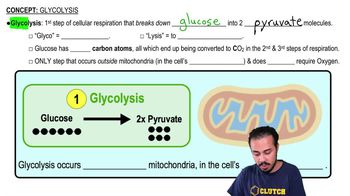
Glycolysis is the first step in both aerobic and anaerobic respiration, where glucose is broken down into pyruvate, producing a small amount of ATP and NADH. This process occurs in the cytoplasm and does not require oxygen. In anaerobic conditions, the pyruvate can be further converted into lactic acid or ethanol, depending on the organism.
Recommended video:

Final Electron Acceptor

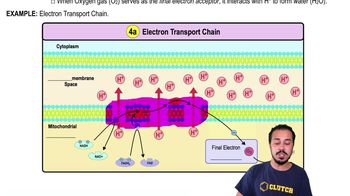
In cellular respiration, the final electron acceptor is a molecule that receives electrons at the end of the electron transport chain. In aerobic respiration, this is typically oxygen, while in anaerobic respiration, other molecules such as sulfate or nitrate may serve this role. The choice of electron acceptor significantly influences the efficiency and byproducts of the respiration process.
Recommended video:
Guided course
07:41
Electron Transport Chain