
Textbook Question
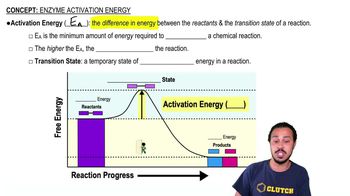
Enzymes speed up chemical reactions by ________.
a. Heating cells
b. Binding to substrates and placing stress on their bonds
c. Changing the shape of the cell
d. Supplying energy to the substrate


 Verified step by step guidance
 04:18
04:18
 02:32
02:32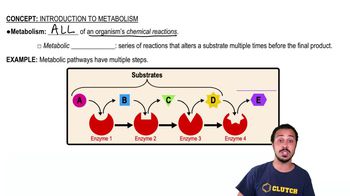 02:17
02:17Enzymes speed up chemical reactions by ________.
a. Heating cells
b. Binding to substrates and placing stress on their bonds
c. Changing the shape of the cell
d. Supplying energy to the substrate
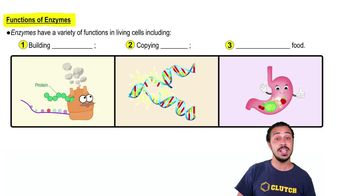
Which of the following is a false statement regarding enzymes?
a. Enzymes are proteins that speed up metabolic reactions.
b. Enzymes have specific substrates.
c. Enzymes supply ATP to their substrates.
d. An enzyme may be used many times.
Cellular respiration involves ________.
a. The aerobic metabolism of sugars in the mitochondria by a process called glycolysis.
b. An electron transport chain that releases carbon dioxide.
c. The synthesis of ATP, which is driven by the rushing of protons through an ATP synthase.
d. Electron carriers that bring electrons to the citric acid cycle; e. the production of water during the citric acid cycle.
The electron transport chain ________.
a. Is located in the matrix of the mitochondrion.
b. Has the electronegative carbon dioxide at its base.
c. Is a series of nucleotides located in the inner mitochondrial membrane.
d. Is a series of enzymes located in the intermembrane space.
e. Moves electrons from protein to protein and moves protons from the matrix into the intermembrane space.
Most of the energy in an ATP molecule is released ________.
a. During cellular respiration.
b. When the terminal phosphate group is hydrolyzed.
c. In the form of new nucleotides.
d. When it is transferred to NADH.