Pearson+ LogoPearson+ Logo
Ch. 17 - The Human Footprint
Belk, Maier - Biology: Science for Life 6th Edition
Belk, Maier6th EditionBiology: Science for LifeISBN: 9780135214084Not the one you use?Change textbook
Chapter 17, Problem 7

Tundra is found
a. Where average temperatures are low and growing seasons are short
b. Near the poles
c. At high altitudes
d. A and B are correct
e. A, B, and C are correct

Verified step by step guidance
1
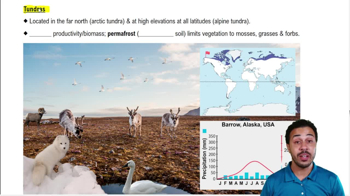
Understand the definition of tundra: Tundra is a biome characterized by extremely cold temperatures, short growing seasons, and limited vegetation, often found in specific geographic and climatic conditions.
Analyze option (a): Tundra is indeed found where average temperatures are low and growing seasons are short. This is a defining feature of the tundra biome.
Analyze option (b): Tundra is commonly found near the poles, such as in the Arctic and Antarctic regions, where the climate supports tundra conditions.
Analyze option (c): Tundra can also be found at high altitudes, such as on mountain ranges, where the environment mimics the cold and short growing seasons of polar tundra.
Combine the correct options: Since all three conditions (a, b, and c) describe environments where tundra is found, the correct answer is (e).

Verified video answer for a similar problem:

This video solution was recommended by our tutors as helpful for the problem above.
Video duration:
1m
Was this helpful?

Key Concepts

Here are the essential concepts you must grasp in order to answer the question correctly.

Tundra Biome Characteristics

The tundra biome is characterized by its cold temperatures, limited precipitation, and short growing seasons. Vegetation is sparse, primarily consisting of mosses, lichens, and low shrubs. The permafrost layer beneath the surface restricts root growth and contributes to the unique ecological conditions of this biome.
Recommended video:

Geographical Distribution of Tundra

Tundra is predominantly found in polar regions, particularly in the Arctic, where it experiences extreme cold and long winters. Additionally, tundra can also occur at high altitudes in mountainous regions, where the climate mimics that of polar areas due to elevation, leading to similar ecological conditions.
Recommended video:
Guided course
03:35
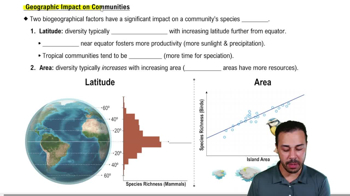
Geographic Impact on Communities

Climate and Ecosystem Interactions

The climate of the tundra, marked by low temperatures and short growing seasons, directly influences its ecosystem. These conditions limit biodiversity and the types of species that can thrive, resulting in a unique set of adaptations among tundra flora and fauna, such as seasonal migration and specialized reproductive strategies.
Recommended video:
Guided course
01:41
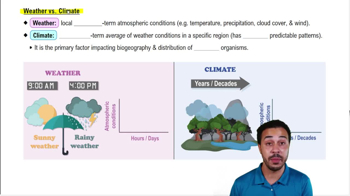
Weather vs. Climate
Related Practice
Textbook Question

Areas of low solar irradiation are

a. Closer to the equator than to the poles

b. Closer to the poles than the equator

c. At high altitudes

d. Close to large bodies of water

e. More than one of the above is correct

Textbook Question

The solar equator, the region of Earth where the sun is directly overhead, moves from 23.5°N to 23.5°S latitudes and back over the course of a year. Why?

a. Earth wobbles on its axis during the year

b. The position of the poles changes by this amount annually

c. Earth's axis is 23.5° from perpendicular to the rays of the sun

d. Earth moves 23.5° toward the sun in summer and 23.5° away from the sun in winter

e. Ocean currents carry heat from the tropical ocean north in summer and south in winter

Textbook Question

Which of the following biomes is most common on Earth's land surface?

a. Chaparral

b. Desert

c. Temperate forest

d. Tundra

e. Boreal forest

1
views
Textbook Question

Which statement best describes the desert biome?

a. It is found wherever temperatures are high

b. It contains a larger amount of biomass per unit area than any other biome

c. Its dominant vegetation is adapted to conserve water

d. Most are located at the equator; e. It is not suitable for human habitation

Textbook Question

Which of the following biomes has a structure made up primarily of the mineral deposits secreted by its dominant organisms

a. Coral reefs

b. Freshwater lakes

c. Rivers

d. Estuaries

e. Oceans

Textbook Question

Which of the following actions can reduce humanity's ecological footprint?

a. Reducing our dependence on fossil fuels

b. Reducing meat consumption

c. Living in higher density settlements

d. Better management of human wastewater

e. All of the above