Pearson+ LogoPearson+ Logo
Ch. 17 - The Human Footprint
Belk, Maier - Biology: Science for Life 6th Edition
Belk, Maier6th EditionBiology: Science for LifeISBN: 9780135214084Not the one you use?Change textbook
Chapter 17, Problem 5

The solar equator, the region of Earth where the sun is directly overhead, moves from 23.5°N to 23.5°S latitudes and back over the course of a year. Why?
a. Earth wobbles on its axis during the year
b. The position of the poles changes by this amount annually
c. Earth's axis is 23.5° from perpendicular to the rays of the sun
d. Earth moves 23.5° toward the sun in summer and 23.5° away from the sun in winter
e. Ocean currents carry heat from the tropical ocean north in summer and south in winter

Verified step by step guidance
1
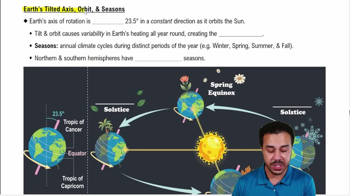
Understand the concept of Earth's axial tilt: Earth's axis is tilted at an angle of approximately 23.5° relative to the perpendicular of its orbital plane around the sun. This tilt is responsible for the changing position of the solar equator throughout the year.
Recognize the movement of the solar equator: The solar equator shifts between 23.5°N (Tropic of Cancer) and 23.5°S (Tropic of Capricorn) latitudes as Earth orbits the sun. This movement is due to the axial tilt and the Earth's revolution around the sun.
Eliminate incorrect options: Analyze each answer choice. For example, Earth does not wobble significantly on its axis during the year (eliminating option a), the position of the poles does not change annually (eliminating option b), and ocean currents do not directly cause the solar equator's movement (eliminating option e).
Focus on the correct explanation: Earth's axial tilt of 23.5° from perpendicular to the sun's rays causes the apparent movement of the solar equator. This tilt results in the sun being directly overhead at different latitudes during different times of the year (supporting option c).
Relate this to seasons: The axial tilt also explains the occurrence of seasons, as different parts of Earth receive varying amounts of sunlight throughout the year. This is why the solar equator shifts between the Tropics of Cancer and Capricorn.

Verified video answer for a similar problem:

This video solution was recommended by our tutors as helpful for the problem above.
Video duration:
1m
Was this helpful?

Key Concepts

Here are the essential concepts you must grasp in order to answer the question correctly.

Axial Tilt

Earth's axis is tilted at an angle of approximately 23.5° relative to its orbital plane around the sun. This axial tilt is responsible for the changing seasons as different parts of the Earth receive varying amounts of sunlight throughout the year. The solar equator shifts between 23.5°N and 23.5°S as the Earth orbits the sun, leading to the phenomenon of the sun being directly overhead at different latitudes during different times of the year.
Recommended video:
Guided course
02:17
Earth’s Tilted Axis, Orbit, & Seasons

Solar Declination

Solar declination refers to the angle between the rays of the sun and the plane of the Earth's equator. As the Earth orbits the sun, the solar declination changes, causing the sun to be directly overhead at different latitudes. This movement of the solar equator from 23.5°N to 23.5°S and back is a direct result of the Earth's axial tilt and its orbit, influencing seasonal weather patterns and daylight hours.
Recommended video:
Guided course
04:23
Community Interactions: Competition (-/-) Example 1

Seasons

Seasons are the result of the Earth's axial tilt and its orbit around the sun, leading to variations in sunlight intensity and duration at different latitudes. During summer in one hemisphere, that region tilts toward the sun, resulting in longer days and more direct sunlight, while the opposite hemisphere experiences winter. This cyclical pattern of seasons is what causes the solar equator to shift between 23.5°N and 23.5°S throughout the year.
Recommended video:
Guided course
03:57
Seasonal Turnover & Ocean Upwelling