Pearson+ LogoPearson+ Logo
Ch. 17 - The Human Footprint
Belk, Maier - Biology: Science for Life 6th Edition
Belk, Maier6th EditionBiology: Science for LifeISBN: 9780135214084Not the one you use?Change textbook
Chapter 17, Problem 9

Which of the following biomes has a structure made up primarily of the mineral deposits secreted by its dominant organisms
a. Coral reefs
b. Freshwater lakes
c. Rivers
d. Estuaries
e. Oceans

Verified step by step guidance
1
Identify the key characteristic of the biome in question: it is primarily composed of mineral deposits secreted by its dominant organisms.
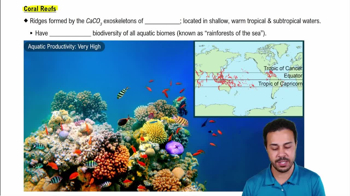
Understand that coral reefs are ecosystems built by coral organisms, which secrete calcium carbonate (CaCO₃) to form their hard exoskeletons. This mineral deposit forms the structure of the reef.
Review the other options: freshwater lakes, rivers, estuaries, and oceans. These biomes do not have structures primarily made of mineral deposits secreted by their dominant organisms.
Coral reefs are unique in this regard because their physical structure is directly created by the biological activity of corals, which are marine invertebrates.
Conclude that the correct answer is the biome where the structure is formed by calcium carbonate secretions, which is coral reefs (option a).

Verified video answer for a similar problem:

This video solution was recommended by our tutors as helpful for the problem above.
Video duration:
1m
Was this helpful?

Key Concepts

Here are the essential concepts you must grasp in order to answer the question correctly.

Biomes

Biomes are large ecological areas on the Earth's surface, characterized by specific climate conditions, flora, and fauna. They are classified based on factors such as temperature, precipitation, and the types of organisms that inhabit them. Understanding biomes is essential for recognizing the diverse ecosystems and their interactions within the environment.
Recommended video:
Guided course
01:38
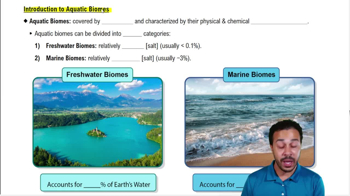
Introduction to Aquatic Biomes

Coral Reefs

Coral reefs are underwater structures made primarily of calcium carbonate, which is secreted by coral polyps, the dominant organisms in these ecosystems. They are known for their biodiversity and play a crucial role in marine life, providing habitat and food for various species. Coral reefs are sensitive to environmental changes, making them important indicators of ocean health.
Recommended video:

Mineral Deposits

Mineral deposits refer to the accumulation of minerals that can form through biological processes, such as the secretion of calcium carbonate by organisms like corals. These deposits contribute to the structural integrity of ecosystems like coral reefs and influence the physical and chemical properties of the surrounding water. Understanding mineral deposits is vital for studying the formation and sustainability of various biomes.
Recommended video:
Guided course
08:24
Food and Feeding