Back
Back
Problem 1
Identify at least one physical factor and one chemical factor that prevent microbes from entering the body through each of the following:
a. Urinary system
b. Genital system
Problem 1
Legionella uses C3b receptors to enter monocytes. This
a. prevents phagocytosis.
b. degrades complement.
c. inactivates complement.
d. prevents inflammation.
e. prevents cytolysis.
Problem 2
Chlamydia can prevent the formation of phagolysosomes and therefore can
a. avoid being phagocytized.
b. avoid destruction by complement.
c. prevent adherence.
d. avoid being digested.
e. none of the above
Problem 2
Define inflammation, and list its characteristics.
Problem 3
What are interferons? Discuss their roles in innate immunity.
Problem 3
If the following are placed in the order of occurrence, which would be the third step?
a. Diapedesis
b. Digestion
c. Formation of a phagosome
d. Formation of a phagolysosome
e. Margination
Problem 4
How can the complement system cause endotoxic shock?
Problem 4
If the following are placed in the order of occurrence, which would be the third step?
a. Activation of C5 through C9
b. Cell lysis
c. Antigen–antibody reaction
d. Activation of C3
e. Activation of C2 through C4
Problem 5
Patients with X-linked chronic granulomatous disease are susceptible to infections because their neutrophils don’t generate an oxidative burst. What is the relation of the oxidative burst to infection?
Problem 5
A human host can prevent a pathogen from getting enough iron by all of the following except
a. reducing dietary intake of iron.
b. binding iron with transferrin.
c. binding iron with hemoglobin.
d. binding iron with ferritin.
e. binding iron with siderophores.
Problem 6
A decrease in the production of C3 would result in
a. increased susceptibility to infection.
b. increased numbers of white blood cells.
c. increased phagocytosis.
d. activation of C5 through C9.
e. none of the above
Problem 6
Why does hemolysis of red blood cells occur when a person receives a transfusion of the wrong type of blood?
Problem 7
Give several examples of how microbes evade the complement system.
Problem 7
In 1884, Elie Metchnikoff observed cells collected around a splinter inserted in a sea star embryo. This was the discovery of
a. blood cells.
b. sea stars.
c. phagocytosis.
d. immunity.
e. none of the above
Problem 8
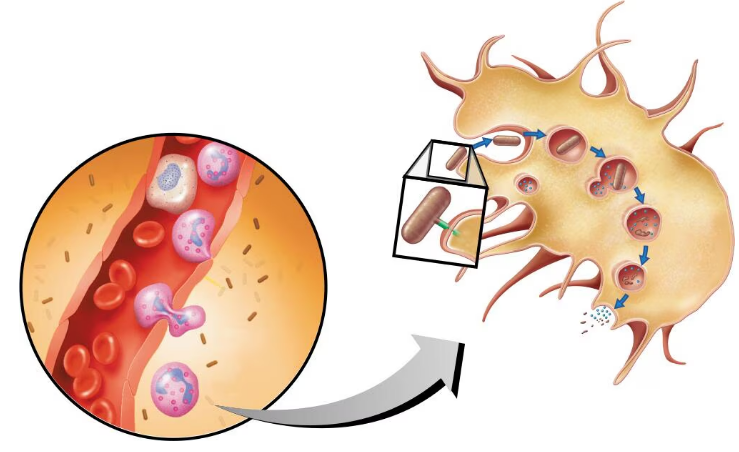
Label on the figure the following processes that result in phagocytosis: margination, diapedesis, adherence, and phagolysosome formation.
Problem 8
Helicobacter pylori uses the enzyme urease to counteract a chemical defense in the human organ in which it lives. This chemical defense is
a. lysozyme.
b. hydrochloric acid.
c. superoxide radicals.
d. sebum.
e. complement.
Problem 9
Are the following involved in innate or in adaptive immunity? Identify the role of each in immunity:
a. TLRs
b. transferrins
c. antimicrobial peptides
Problem 9
Which of the following statements about IFN-α is false?
a. It interferes with viral replication.
b. It is host-cell–specific.
c. It is released by fibroblasts.
d. It is virus-specific.
e. It is released by lymphocytes.
Problem 10
Which of the following does not stimulate phagocytes?
a. Cytokines
b. IFN-y
c. C3b
d. Lipid A
e. Histamine
Problem 10
These agranulocytes are not phagocytic until they wander out of the blood.