Back
Back
Problem 1
Amphotericin B is considered the “gold standard” of antifungal agents. Technically, its mode of action works against most fungal infections. Why, then, isn’t it prescribed for most fungal infections?
Problem 1
Indicate whether each statement is true or false. If the statement is false, change the underlined word or phrase to make the statement true.
_____ Fungi are generally not transmitted from person to person.
Problem 1
A fungus that can infect both healthy and immunocompromised patients is called
a(n) _______.
a. true pathogen
b. opportunistic pathogen
c. commensal organism
d. symbiotic organism
Problem 1
Dimorphic fungi exist as _____ forms in the environment and as _____ forms in their hosts.
Problem 1
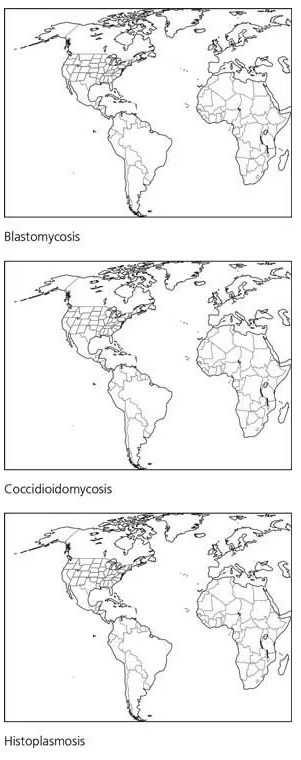
Color each map below to show the general area where each disease is endemic.
Problem 1
Match each of the following diseases with the manner(s) in which fungi enter the body. Answers can be used more than once.
1. ___ Aspergillosis
2. ___Candidiasis
3. ___Chromoblastomycosis
4. ___ Coccidioidomycosis
5. ___ Cryptococcosis
6. ___Dermatophytosis
7. ___ Histoplasmosis
8. ___ Hypersensitivity reactions
9. ___ Mushroom poisoning
10. ___ Mycetoma
11. ___ Sporotrichosis
A. Inhalation
B. Contact
C. Trauma
D. Ingestion
Problem 2
Indicate whether each statement is true or false. If the statement is false, change the underlined word or phrase to make the statement true.
_____ On the whole, fungal infections are relatively easy to treat.
Problem 2
The true fungal pathogens are _____ , _____ , _____ , and_____ (give genus and specific epithet).
Problem 2
Identify these fungal genera.
a.
b.
c.
Problem 2
Discuss why it is difficult in many cases to determine the source of superficial fungal infections (i.e., from other humans, animals, or the environment).
Problem 2
Of the following fungi, which is usually transmitted from person to person?
a. Blastomyces dermatitidis
b. Coccidioides immitis
c. Tricophyton rubrum
d. Aspergillus fumigatus
Problem 3
Given that superficial fungal infections are only on the surface, why is it necessary to even try to identify the source of infection?
Problem 3
Indicate whether each statement is true or false. If the statement is false, change the underlined word or phrase to make the statement true.
_____ Dermatophytoses are always contracted from the environment.
Problem 3
Many antifungal agents target the compound _____ in fungal cytoplasmic membranes.
Problem 3
Which of the following is not used to identify true fungal pathogens?
a. Growth at 25°C and 37°C to show dimorphism
b. GMS staining of infected tissues
c. Serological testing
d. Clinical symptoms alone
Problem 4
Because amphotericin B is toxic to humans, most clinicians prescribe it only for ______.
a. dermatophyte infections
b. Malassezia infections
c. systemic infections
d. mushroom poisoning
Problem 4
_____ are tumorlike fungal infections.
Problem 4
AIDS patients usually die of bacterial, fungal, or microsporidial infections. Why do so many fungal infections appear in these individuals, and why are mycoses severe while fungi, for the most part, are benign residents of the environment?
Problem 4
Indicate whether each statement is true or false. If the statement is false, change the underlined word or phrase to make the statement true.
_____ Chromoblastomycosis and phaeohyphomycosis are both caused by dark-pigmented ascomycetes.
Problem 5
Sporotrichosis is caused by the traumatic introduction of ______ into the skin (give genus and species).
Problem 5
Ringworm is caused by a____
a. helminth
b. dermatophyte
c. dimorphic fungus
d. commensal fungus
Problem 5
How does mycotoxicosis differ from mycetismus?
Problem 5
Indicate whether each statement is true or false. If the statement is false, change the underlined word or phrase to make the statement true.
_____ Sporotrichosis is often caused by introduction of fungi beneath the skin by a thorn prick.
Problem 6
Which of the following is considered a classical opportunistic fungus?
a. Blastomyces
b. Histoplasma
c. Fonsecaea
d. Aspergillus
Problem 6
Indicate whether each statement is true or false. If the statement is false, change the underlined word or phrase to make the statement true.
_____ Coccidioidomycosis does not occur normally outside the Western Hemisphere.
Problem 6
Which pathogenic fungus is associated with bird droppings? _____ _____ (give genus and species).
Problem 7
The five more common agents of opportunistic fungal infections are _____ , _____ , _____ , _____ , and _____ (genus names).
Problem 7
Subcutaneous infections tend to be acquired through ________.
a. inhalation and remain localized
b. inhalation and become systemic
c. trauma and remain localized
d. trauma and become systemic
Problem 8
Thrush is caused by _____ (genus name).
Problem 8
The term dermatophyte refers to_____.
a. pathogenicity
b. where a fungus grows
c. method of spread
d. pigmentation