Back
Back
Problem 1
Why was the theory of spontaneous generation a hindrance to the development of the field of microbiology?
Problem 1
Match each of the following descriptions with the person it best describes more than once or not at all. An answer may be used more than once.
1. Developed smallpox immunization
2. First photomicrograph of bacteria
3. Used mathematical data to improve nursing
4. Germs cause disease
5. Sought a “magic bullet” to destroy pathogens
6. Early epidemiologist
7. Father of Microbiology
8. Classification system
9. Discoverer of bacteria
10. Discoverer of protozoa
11. Founder of antiseptic surgery
12. Developed the most widely used bacterial staining technique
A. John Snow
B. Paul Ehrlich
C. Louis Pasteur
D. Antoni van Leeuwenhoek
E. Carolus Linnaeus
F. John Needham
G. Eduard Buchner
H. Robert Koch
I. Joseph Lister
J. Edward Jenner
K. Girolamo Fracastoro
L. Hans Christian Gram
M. Florence Nightingale
Problem 1
On the following photos, label cilium, flagellum, nucleus, and pseudopod.
<IMAGE>
Problem 1
Which of the following microorganisms are not eukaryotic?
a) Bacteria
b) Yeasts
c) Molds
d) Protozoa
Problem 1
Fill in the blanks with the name(s) of the scientist(s) whose investigations led to the following fields of study in microbiology.
Environmental microbiology ___________ and _____________
Problem 2
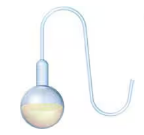
Show where microbes ended up in Pasteur’s experiment.
Problem 2
Fill in the blanks with the name(s) of the scientist(s) whose investigations led to the following fields of study in microbiology.
Biochemistry _________ and __________.
Problem 2
Which microorganisms are used to make microbiological growth media?
a. Bacteria
b. Fungi
c. Algae
d. Protozoa
Problem 3
Fill in the blanks with the name(s) of the scientist(s) whose investigations led to the following fields of study in microbiology.
Chemotherapy ____________.
Problem 3
List six types of microorganisms.
Problem 3
In which habitat would you most likely find archaea?
a. Acidic hot springs
b. Swamp mud
c. Great Salt Lake
d. All of the above
Problem 4
Defend this statement: “The investigations of Antoni van Leeuwenhoek changed the world forever.”
Problem 4
Of the following scientists, who first promulgated the theory of abiogenesis?
a. Aristotle
b. Pasteur
c. Needham
d. Spallanzani
Problem 4
Fill in the blanks with the name(s) of the scientist(s) whose investigations led to the following fields of study in microbiology.
Immunology____________.
Problem 5
Which of the following scientists hypothesized that a bacterial colony arises from a single bacterial cell?
a. Antoni van Leeuwenhoek
b. Louis Pasteur
c. Robert Koch
d. Richard Petri
Problem 5
Fill in the blanks with the name(s) of the scientist(s) whose investigations led to the following fields of study in microbiology.
Infection control ____________.
Problem 5
Why would a macroscopic tapeworm be studied in microbiology?
Problem 6
Fill in the blanks with the name(s) of the scientist(s) whose investigations led to the following fields of study in microbiology.
Etiology ____________.
Problem 6
Which scientist first hypothesized that medical personnel can infect patients with pathogens?
a. Florence Nightingale
b. Joseph Lister
c. John Snow
d. Ignaz Semmelweis
Problem 6
Describe what has been called the “Golden Age of Microbiology” with reference to four major questions that propelled scientists during that period.
Problem 7
List four major questions that drive microbiological investigations today.
Problem 7
Fill in the blanks with the name(s) of the scientist(s) whose investigations led to the following fields of study in microbiology.
Epidemiology ____________.
Problem 7
Van Leeuwenhoek described microorganisms as:
a. Animalcules
b. Prokaryotes
c. Eukaryotes
d. Protozoa
Problem 8
Refer to the four steps in the scientific method in describing Pasteur’s fermentation experiments.
Problem 8
Which of the following favored the theory of spontaneous generation?
a. Spallanzani
b. Needham
c. Pasteur
d. Koch
Problem 8
Fill in the blanks with the name(s) of the scientist(s) whose investigations led to the following fields of study in microbiology.
Biotechnology ____________
Problem 9
List Koch’s postulates, and explain why they are significant.
Problem 9
A scientist who studies the role of microorganisms in the environment is a(n):
a. Genetic technologist
b. Earth microbiologist
c. Epidemiologist
d. Environmental microbiologist
Problem 9
Fill in the blanks with the name(s) of the scientist(s) whose investigations led to the following fields of study in microbiology.
Food microbiology ____________.
Problem 10
The laboratory of Robert Koch contributed which of the following to the field of microbiology?
a. Simple staining technique
b. Use of Petri dishes
c. First photomicrograph of bacteria
d. All of the above