Pearson+ LogoPearson+ Logo
Ch.17 Nucleic Acids and Protein Synthesis
Timberlake - Chemistry: An Introduction to General, Organic, and Biological Chemistry 13th Edition
Timberlake13th EditionChemistry: An Introduction to General, Organic, and Biological ChemistryISBN: 9780134421353Not the one you use?Change textbook
Chapter 17, Problem 90c

Suppose a mutation occurs in the DNA section in problem 17.89, and the first base in the parent chain, adenine, is replaced by guanine.
c. Write the three-letter symbols for the amino acids that would go into the peptide from the mRNA you wrote in part b.

Verified step by step guidance
1
Step 1: Understand the context of the problem. A mutation in DNA involves a change in the nucleotide sequence. Here, adenine (A) is replaced by guanine (G). This change will affect the mRNA sequence transcribed from the DNA and potentially alter the amino acid sequence in the resulting peptide.
Step 2: Recall the process of transcription. DNA serves as a template for mRNA synthesis. The base pairing rules are: adenine (A) pairs with uracil (U) in RNA, thymine (T) pairs with adenine (A), cytosine (C) pairs with guanine (G), and guanine (G) pairs with cytosine (C). Use these rules to write the new mRNA sequence based on the mutated DNA.
Step 3: Translate the mRNA sequence into a sequence of codons. Each codon is a group of three nucleotides that corresponds to a specific amino acid. Use the genetic code table to identify the amino acids associated with each codon in the mRNA sequence.
Step 4: Write the three-letter symbols for the amino acids in the peptide chain. For example, if the codons in the mRNA sequence are AUG, UUU, and GGC, the corresponding amino acids would be Met (Methionine), Phe (Phenylalanine), and Gly (Glycine).
Step 5: Consider the impact of the mutation. Compare the amino acid sequence derived from the mutated mRNA to the original sequence. Determine if the mutation caused a change in the peptide's amino acid sequence, which could affect the protein's structure and function.

Verified video answer for a similar problem:

This video solution was recommended by our tutors as helpful for the problem above.
Video duration:
5m
Was this helpful?

Key Concepts

Here are the essential concepts you must grasp in order to answer the question correctly.

DNA Mutation

A DNA mutation is a change in the nucleotide sequence of an organism's genome. This can occur due to various factors, including errors during DNA replication or external influences like radiation. Mutations can lead to changes in the amino acid sequence of proteins, potentially altering their function. In this case, the substitution of adenine with guanine may affect the resulting mRNA and the corresponding peptide.
Recommended video:
Guided course
5:08
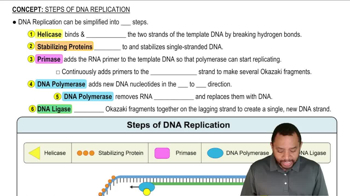
Steps of DNA Replication Concept 1

Transcription and mRNA

Transcription is the process by which the genetic information in DNA is copied into messenger RNA (mRNA). During this process, RNA polymerase synthesizes mRNA by pairing complementary RNA nucleotides with the DNA template strand. The mRNA serves as a template for protein synthesis during translation, where the sequence of nucleotides is translated into a sequence of amino acids, forming a peptide.
Recommended video:
Guided course
6:37
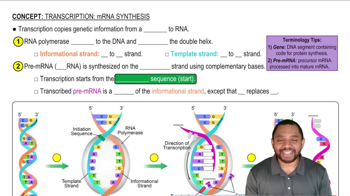
Transcription: mRNA Synthesis Concept 1

Amino Acid Codons

Amino acids are the building blocks of proteins, and each amino acid is encoded by a specific sequence of three nucleotides known as a codon. The genetic code is universal, meaning that the same codons specify the same amino acids across different organisms. Understanding the codons derived from the mRNA is essential for determining which amino acids will be incorporated into the peptide, especially after a mutation alters the original sequence.
Recommended video:
Guided course
3:03
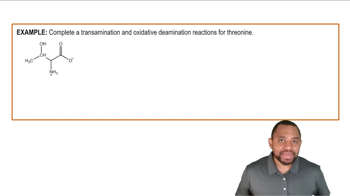
Amino Acid Catabolism: Amino Group Example 2