Pearson+ LogoPearson+ Logo
Ch.17 Nucleic Acids and Protein Synthesis
Timberlake - Chemistry: An Introduction to General, Organic, and Biological Chemistry 13th Edition
Timberlake13th EditionChemistry: An Introduction to General, Organic, and Biological ChemistryISBN: 9780134421353Not the one you use?Change textbook
Chapter 17, Problem 28d

Write the base sequence in a complementary DNA segment if each original segment has the following base sequence:
d. A T A T G C G C T A A A

Verified step by step guidance
1
Understand the concept of complementary base pairing in DNA. In DNA, adenine (A) pairs with thymine (T), and cytosine (C) pairs with guanine (G).
Write down the original DNA sequence provided: A T A T G C G C T A A A.
For each base in the original sequence, determine its complementary base using the base pairing rules: A pairs with T, T pairs with A, G pairs with C, and C pairs with G.
Replace each base in the original sequence with its complementary base to form the complementary DNA strand. For example, the first base 'A' will pair with 'T', the second base 'T' will pair with 'A', and so on.
Write the final complementary DNA sequence as a single strand, ensuring the order of bases matches the complementary pairing determined in the previous step.

Verified video answer for a similar problem:

This video solution was recommended by our tutors as helpful for the problem above.
Video duration:
2m
Was this helpful?

Key Concepts

Here are the essential concepts you must grasp in order to answer the question correctly.

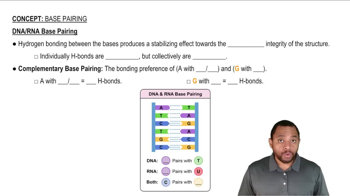
DNA Base Pairing

DNA base pairing is the principle that describes how nucleotide bases pair with each other in a DNA molecule. Adenine (A) pairs with Thymine (T), and Cytosine (C) pairs with Guanine (G). This complementary pairing is crucial for the structure of DNA and ensures accurate replication and transcription.
Recommended video:
Guided course
2:56
Base Pairing Concept 1

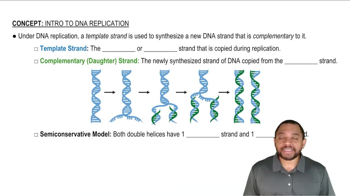
Complementary DNA Strand

A complementary DNA strand is formed by pairing each base of the original DNA sequence with its corresponding partner. For example, if the original strand has an 'A', the complementary strand will have a 'T'. This concept is essential for understanding how DNA replicates and how genetic information is preserved.
Recommended video:
Guided course
2:20
Intro to DNA Replication Concept 1

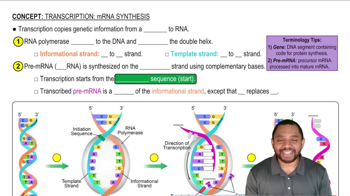
Transcription and Replication

Transcription and replication are two fundamental processes involving DNA. Replication is the process by which DNA makes a copy of itself, while transcription is the synthesis of RNA from a DNA template. Understanding these processes is vital for grasping how genetic information is transferred and expressed in living organisms.
Recommended video:
Guided course
6:37
Transcription: mRNA Synthesis Concept 1