Pearson+ LogoPearson+ Logo
Ch.15 Lipids
Timberlake - Chemistry: An Introduction to General, Organic, and Biological Chemistry 13th Edition
Timberlake13th EditionChemistry: An Introduction to General, Organic, and Biological ChemistryISBN: 9780134421353Not the one you use?Change textbook
Chapter 15, Problem 74a

 Identify each of the following as a saturated, monounsaturated, polyunsaturated, omega-3, or omega-6 fatty acid:
a. Chemical structure of a fatty acid with multiple double bonds, indicating its classification as polyunsaturated.

Verified step by step guidance
1
Step 1: Understand the definitions of the terms provided in the problem. A saturated fatty acid contains no double bonds between carbon atoms in its hydrocarbon chain. A monounsaturated fatty acid contains one double bond, while a polyunsaturated fatty acid contains two or more double bonds. Omega-3 and omega-6 fatty acids are types of polyunsaturated fatty acids, where the first double bond is located at the third or sixth carbon from the omega (methyl) end of the chain, respectively.
Step 2: Examine the structure of the fatty acid in the provided image. Look for the presence and number of double bonds in the hydrocarbon chain. If there are no double bonds, it is saturated. If there is one double bond, it is monounsaturated. If there are two or more double bonds, it is polyunsaturated.
Step 3: If the fatty acid is polyunsaturated, determine the position of the first double bond relative to the omega (methyl) end of the chain. Count the carbon atoms starting from the omega end until you reach the first double bond. If the first double bond is at the third carbon, it is an omega-3 fatty acid. If it is at the sixth carbon, it is an omega-6 fatty acid.
Step 4: Repeat the analysis for each fatty acid structure provided in the images. Carefully count the number of double bonds and their positions to classify each fatty acid correctly.
Step 5: Summarize your findings for each fatty acid, specifying whether it is saturated, monounsaturated, polyunsaturated, omega-3, or omega-6 based on the structural analysis.

Verified video answer for a similar problem:

This video solution was recommended by our tutors as helpful for the problem above.
Video duration:
3m
Was this helpful?

Key Concepts

Here are the essential concepts you must grasp in order to answer the question correctly.

Types of Fatty Acids

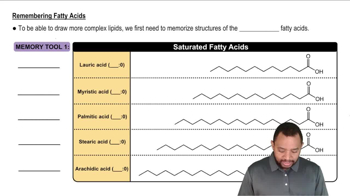
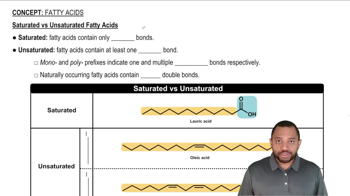
Fatty acids are categorized based on their chemical structure. Saturated fatty acids have no double bonds between carbon atoms, while unsaturated fatty acids contain one or more double bonds. Monounsaturated fatty acids have one double bond, and polyunsaturated fatty acids have multiple double bonds. Omega-3 and omega-6 fatty acids are specific types of polyunsaturated fats that are essential for human health.
Recommended video:
Guided course
1:50
Fatty Acids Concept 5

Saturated Fatty Acids

Saturated fatty acids are typically solid at room temperature and are found in animal fats and some plant oils. They are characterized by their lack of double bonds, which allows them to pack closely together. High intake of saturated fats is often linked to increased cholesterol levels and heart disease, making it important to monitor their consumption.
Recommended video:
Guided course
2:26
Fatty Acids Concept 2

Unsaturated Fatty Acids

Unsaturated fatty acids are generally liquid at room temperature and are found in plant oils, nuts, and fish. They are divided into monounsaturated and polyunsaturated fats. Monounsaturated fats, like those found in olive oil, can help reduce bad cholesterol levels, while polyunsaturated fats, including omega-3 and omega-6 fatty acids, are crucial for brain function and cell growth.
Recommended video:
Guided course
2:26
Fatty Acids Concept 2