Pearson+ LogoPearson+ Logo
Ch.14 Carboxylic Acids, Esters, Amines, and Amides
Timberlake - Chemistry: An Introduction to General, Organic, and Biological Chemistry 13th Edition
Timberlake13th EditionChemistry: An Introduction to General, Organic, and Biological ChemistryISBN: 9780134421353Not the one you use?Change textbook
Chapter 14, Problem 59c

Draw the condensed structural formulas for a and b and line-angle formulas for c and d:
c. 3-bromopentanoic acid

Verified step by step guidance
1
Identify the parent chain: The name '3-bromopentanoic acid' indicates that the parent chain is 'pentanoic acid,' which is a five-carbon carboxylic acid (COOH group at one end).
Locate the substituent: The '3-bromo' prefix tells us that a bromine atom is attached to the third carbon of the pentanoic acid chain. Number the carbon atoms starting from the carboxylic acid carbon (C1).
Draw the condensed structural formula: Start with the carboxylic acid group (COOH) at one end, then write the chain of carbons with hydrogens attached, and include the bromine atom on the third carbon. The condensed formula should look like CH3-CH(Br)-CH2-CH2-COOH.
Draw the line-angle formula: Represent the carbon chain as a zigzag line, with the carboxylic acid group (COOH) at one end. Place a 'Br' label on the third carbon to indicate the bromine substituent. Remember that each vertex represents a carbon atom, and hydrogens are implied unless otherwise specified.
Double-check the structure: Ensure that the total number of bonds for each carbon is correct (four bonds per carbon), and confirm that the bromine atom is correctly placed on the third carbon.

Verified video answer for a similar problem:

This video solution was recommended by our tutors as helpful for the problem above.
Video duration:
2m
Was this helpful?

Key Concepts

Here are the essential concepts you must grasp in order to answer the question correctly.

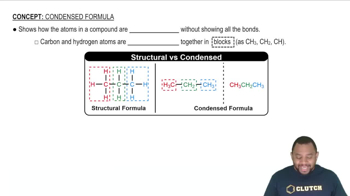
Condensed Structural Formula

A condensed structural formula is a way of representing a chemical compound that shows the arrangement of atoms and the connectivity between them without depicting all the bonds explicitly. It typically groups atoms together to indicate how they are connected, making it easier to visualize the structure of the molecule in a compact form.
Recommended video:
Guided course
1:53
Condensed Formula Concept 1

Line-Angle Formula

A line-angle formula, also known as a skeletal formula, is a simplified representation of organic molecules where vertices represent carbon atoms and lines represent bonds. This method omits hydrogen atoms attached to carbons, making it easier to visualize complex structures and focus on functional groups and connectivity.
Recommended video:
Guided course
01:24
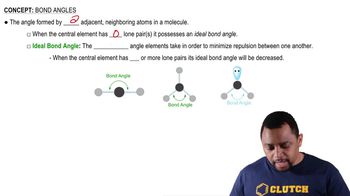
Bond Angles (Simplified) Concept 1

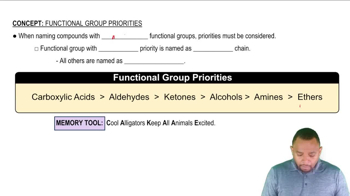
Functional Groups

Functional groups are specific groups of atoms within molecules that are responsible for the characteristic chemical reactions of those molecules. In the case of 3-bromopentanoic acid, the carboxylic acid group (-COOH) is the functional group that defines its acidic properties, while the bromine atom introduces additional reactivity.
Recommended video:
Guided course
1:11
Functional Group Priorities Concept 1