Pearson+ LogoPearson+ Logo
Ch.14 Carboxylic Acids, Esters, Amines, and Amides
Timberlake - Chemistry: An Introduction to General, Organic, and Biological Chemistry 13th Edition
Timberlake13th EditionChemistry: An Introduction to General, Organic, and Biological ChemistryISBN: 9780134421353Not the one you use?Change textbook
Chapter 14, Problem 4b

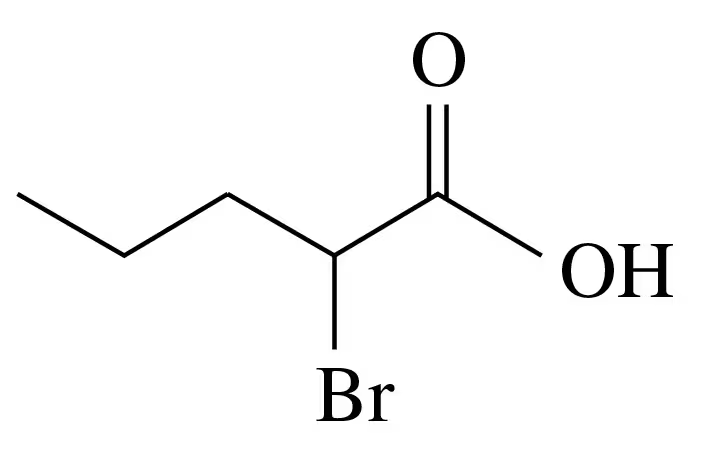
Write the IUPAC and common name, if any, for each of the following carboxylic acids:
b. Structural formula of a carboxylic acid with a bromine atom, showing functional groups: -COOH and -Br.

Verified step by step guidance
1
Step 1: Identify the functional group in the given compound. Carboxylic acids are characterized by the presence of a carboxyl group (-COOH). Locate this group in the structure provided in the image.
Step 2: Determine the longest continuous carbon chain that includes the carboxyl group. This chain will serve as the parent chain for naming the compound.
Step 3: Number the carbon atoms in the parent chain starting from the carbon in the carboxyl group. This ensures the carboxyl group is assigned the lowest possible number.
Step 4: Identify and name any substituents attached to the parent chain. Use prefixes to indicate their position and type, based on the numbering established in Step 3.
Step 5: Combine the substituent names, parent chain name, and the suffix '-oic acid' (used for carboxylic acids) to form the IUPAC name. If the compound has a common name, refer to standard naming conventions for carboxylic acids to provide it.

Verified video answer for a similar problem:

This video solution was recommended by our tutors as helpful for the problem above.
Video duration:
3m
Was this helpful?

Key Concepts

Here are the essential concepts you must grasp in order to answer the question correctly.

Carboxylic Acids

Carboxylic acids are organic compounds characterized by the presence of one or more carboxyl groups (-COOH). They are known for their acidic properties due to the ability of the carboxyl group to donate a proton (H+). Common examples include acetic acid and citric acid, which are widely used in food and industry.
Recommended video:
Guided course
1:09
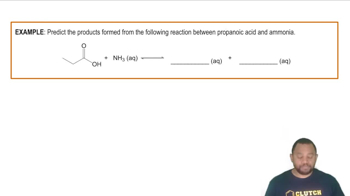
Carboxylic Acid Reactions Example 1

IUPAC Nomenclature

The International Union of Pure and Applied Chemistry (IUPAC) nomenclature provides a systematic method for naming chemical compounds. For carboxylic acids, the IUPAC name is derived from the longest carbon chain containing the carboxyl group, with the suffix '-oic acid' added. This standardized naming helps avoid confusion and ensures clarity in chemical communication.
Recommended video:
Guided course
3:18
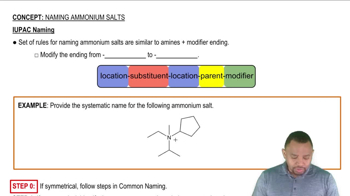
IUPAC Naming Concept 3

Common Names

Common names are traditional names for chemical compounds that may not follow systematic naming rules. For carboxylic acids, many have widely recognized common names, such as acetic acid for ethanoic acid and formic acid for methanoic acid. These names are often used in everyday language and can be more familiar to the general public than their IUPAC counterparts.