Pearson+ LogoPearson+ Logo
Ch.14 Carboxylic Acids, Esters, Amines, and Amides
Timberlake - Chemistry: An Introduction to General, Organic, and Biological Chemistry 13th Edition
Timberlake13th EditionChemistry: An Introduction to General, Organic, and Biological ChemistryISBN: 9780134421353Not the one you use?Change textbook
Chapter 14, Problem 16b

Draw the condensed structural formula for the ester formed when each of the following reacts with ethyl alcohol: 
b. propionic acid

Verified step by step guidance
1
Understand the reaction: An ester is formed when a carboxylic acid reacts with an alcohol in the presence of an acid catalyst. This is known as esterification. In this case, propionic acid (C2H5COOH) reacts with ethyl alcohol (C2H5OH).
Identify the functional groups: Propionic acid contains a carboxylic acid group (-COOH), and ethyl alcohol contains a hydroxyl group (-OH). During esterification, the -OH group from the carboxylic acid and the hydrogen atom from the alcohol's -OH group are removed to form water (H2O).
Combine the remaining fragments: After the removal of water, the oxygen atom from the alcohol bonds to the carbon atom of the carboxylic acid group, forming the ester functional group (-COO-).
Write the condensed structural formula: The ester formed will have the structure where the ethyl group (C2H5) from ethyl alcohol is attached to the oxygen atom, and the propionyl group (C2H5CO-) from propionic acid forms the rest of the molecule.
Verify the final structure: The condensed structural formula for the ester is C2H5COOC2H5. This represents ethyl propionate, the ester formed from the reaction.

Verified video answer for a similar problem:

This video solution was recommended by our tutors as helpful for the problem above.
Video duration:
2m
Was this helpful?

Key Concepts

Here are the essential concepts you must grasp in order to answer the question correctly.

Esterification Reaction

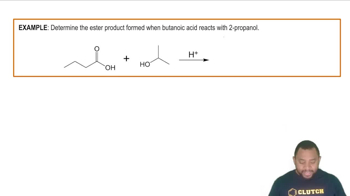
Esterification is a chemical reaction between an alcohol and a carboxylic acid, resulting in the formation of an ester and water. In this process, the hydroxyl group (-OH) from the acid and a hydrogen atom from the alcohol combine to release water, while the remaining parts form the ester. Understanding this reaction is crucial for drawing the correct structural formula.
Recommended video:
Guided course
0:46
Ester Reactions: Esterification Example 1

Condensed Structural Formula

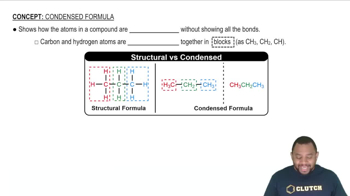
A condensed structural formula is a way of representing a chemical structure that shows the arrangement of atoms in a molecule without depicting all the bonds explicitly. It typically groups atoms together to indicate how they are connected, making it easier to visualize the molecular structure. This format is particularly useful for esters, as it simplifies the representation of larger molecules.
Recommended video:
Guided course
1:53
Condensed Formula Concept 1

Propionic Acid

Propionic acid, also known as propanoic acid, is a carboxylic acid with the chemical formula C3H6O2. It consists of a three-carbon chain with a carboxyl group (-COOH) at one end. When propionic acid reacts with ethyl alcohol, it forms ethyl propionate, an ester, which is important in various applications, including food preservation and flavoring.
Recommended video: