Pearson+ LogoPearson+ Logo
Ch.12 Alcohols, Thiols, Ethers, Aldehydes, and Ketones
Timberlake - Chemistry: An Introduction to General, Organic, and Biological Chemistry 13th Edition
Timberlake13th EditionChemistry: An Introduction to General, Organic, and Biological ChemistryISBN: 9780134421353Not the one you use?Change textbook
Chapter 12, Problem 66a

A compound with the formula C5H10O oxidizes to give 3-pentanone. Draw the condensed structural formula and give the IUPAC name for the compound.

Verified step by step guidance
1
Identify the functional group in the product, 3-pentanone. Since it is a ketone, the starting compound must be an alcohol that can be oxidized to form this ketone.
Determine the structure of 3-pentanone. Its condensed structural formula is CH₃-CH₂-CO-CH₂-CH₃, where the ketone group (C=O) is on the third carbon of the pentane chain.
Recall that primary alcohols oxidize to aldehydes and then to carboxylic acids, while secondary alcohols oxidize to ketones. Since the product is a ketone, the starting compound must be a secondary alcohol.
Place the hydroxyl group (-OH) on the carbon that will become the ketone group after oxidation. In this case, the hydroxyl group should be on the third carbon of the pentane chain, resulting in the compound CH₃-CH₂-CHOH-CH₂-CH₃.
Name the compound using IUPAC rules. The parent chain is pentane, and the hydroxyl group is on the third carbon. The IUPAC name is 3-pentanol.

Verified video answer for a similar problem:

This video solution was recommended by our tutors as helpful for the problem above.
Was this helpful?

Key Concepts

Here are the essential concepts you must grasp in order to answer the question correctly.

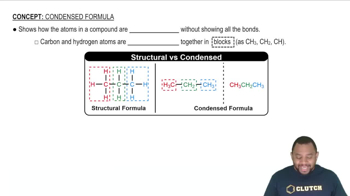
Condensed Structural Formula

A condensed structural formula is a way of representing a chemical compound that shows the arrangement of atoms in a molecule while omitting some of the bonds. It typically groups atoms together to indicate how they are connected, making it easier to visualize the structure without drawing every bond explicitly. For example, the condensed formula for pentane is CH₃(CH₂)₃CH₃, indicating a straight-chain alkane.
Recommended video:
Guided course
1:53
Condensed Formula Concept 1

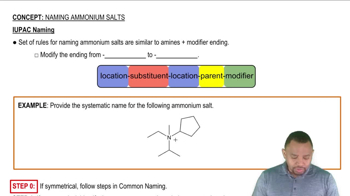
IUPAC Nomenclature

IUPAC nomenclature is a systematic method for naming chemical compounds established by the International Union of Pure and Applied Chemistry. It provides a unique name for each compound based on its structure, ensuring clarity and consistency in chemical communication. For instance, the name '3-pentanone' indicates a ketone functional group located on the third carbon of a five-carbon chain.
Recommended video:
Guided course
3:18
IUPAC Naming Concept 3

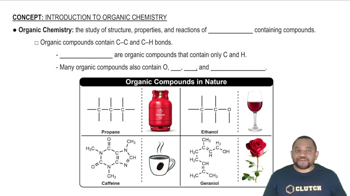
Oxidation in Organic Chemistry

In organic chemistry, oxidation refers to the process of increasing the oxidation state of a molecule, often involving the addition of oxygen or the removal of hydrogen. This transformation can lead to the formation of carbonyl compounds, such as ketones and aldehydes. In the context of the question, the oxidation of a compound with the formula C₅H₁₀O results in the formation of 3-pentanone, illustrating this concept.
Recommended video:
Guided course
2:26
Introduction to Organic Chemistry Concept 1