Pearson+ LogoPearson+ Logo
Ch.11 Introduction to Organic Chemistry: Hydrocarbons
Timberlake - Chemistry: An Introduction to General, Organic, and Biological Chemistry 13th Edition
Timberlake13th EditionChemistry: An Introduction to General, Organic, and Biological ChemistryISBN: 9780134421353Not the one you use?Change textbook
Chapter 11, Problem 39c

Write the balanced chemical equation for the complete combustion of each of the following hydrocarbons found in gasoline:
c. 3-ethyltoluene

Verified step by step guidance
1
Identify the molecular formula of 3-ethyltoluene. It consists of a benzene ring with a methyl group (CH₃) and an ethyl group (C₂H₅) attached. Its molecular formula is C₉H₁₂.
Write the general formula for the complete combustion of a hydrocarbon: CₓHᵧ + O₂ → CO₂ + H₂O. This represents the reaction of the hydrocarbon with oxygen to produce carbon dioxide and water.
Balance the carbon atoms first. Since there are 9 carbon atoms in C₉H₁₂, place a coefficient of 9 in front of CO₂: C₉H₁₂ + O₂ → 9CO₂ + H₂O.
Balance the hydrogen atoms next. There are 12 hydrogen atoms in C₉H₁₂, so place a coefficient of 6 in front of H₂O: C₉H₁₂ + O₂ → 9CO₂ + 6H₂O.
Balance the oxygen atoms. There are 9 × 2 = 18 oxygen atoms from CO₂ and 6 × 1 = 6 oxygen atoms from H₂O, for a total of 24 oxygen atoms. Place a coefficient of 12 in front of O₂ to balance the equation: C₉H₁₂ + 12O₂ → 9CO₂ + 6H₂O.

Verified video answer for a similar problem:

This video solution was recommended by our tutors as helpful for the problem above.
Was this helpful?

Key Concepts

Here are the essential concepts you must grasp in order to answer the question correctly.

Combustion Reaction

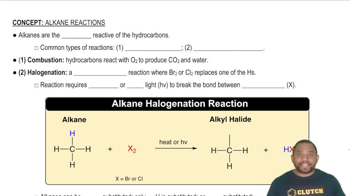
A combustion reaction is a chemical process in which a substance reacts rapidly with oxygen, producing heat and light. In the case of hydrocarbons, this typically results in the formation of carbon dioxide and water. Complete combustion occurs when there is sufficient oxygen, leading to the full oxidation of the hydrocarbon.
Recommended video:
Guided course
2:25
Common Types of Alkane Reactions Concept 1

Hydrocarbons

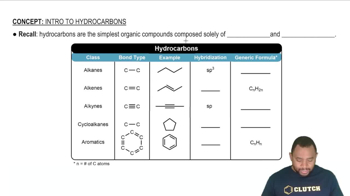
Hydrocarbons are organic compounds composed solely of hydrogen and carbon atoms. They are the primary constituents of fossil fuels, including gasoline. The structure of hydrocarbons can vary significantly, influencing their combustion properties and the products formed during combustion.
Recommended video:
Guided course
4:29
Intro to Hydrocarbons Concept 1

Balancing Chemical Equations

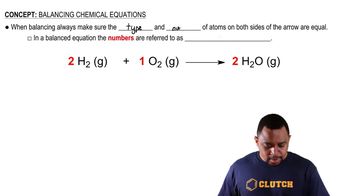
Balancing chemical equations involves ensuring that the number of atoms of each element is the same on both sides of the equation. This is crucial for adhering to the law of conservation of mass. In combustion reactions, balancing helps to accurately represent the stoichiometry of reactants and products, which is essential for understanding the reaction's efficiency and environmental impact.
Recommended video:
Guided course
01:32
Balancing Chemical Equations (Simplified) Concept 1