Pearson+ LogoPearson+ Logo
Ch.11 Introduction to Organic Chemistry: Hydrocarbons
Timberlake - Chemistry: An Introduction to General, Organic, and Biological Chemistry 13th Edition
Timberlake13th EditionChemistry: An Introduction to General, Organic, and Biological ChemistryISBN: 9780134421353Not the one you use?Change textbook
Chapter 11, Problem 21b

Write the balanced chemical equation for the complete combustion of each of the following compounds:
b. cyclopropane

Verified step by step guidance
1
Step 1: Understand the concept of combustion. Combustion is a chemical reaction where a hydrocarbon reacts with oxygen (O₂) to produce carbon dioxide (CO₂) and water (H₂O). This is a complete combustion reaction.
Step 2: Write the molecular formula for cyclopropane. Cyclopropane is a cyclic hydrocarbon with the formula C₃H₆.
Step 3: Write the unbalanced chemical equation for the combustion of cyclopropane. The general form is: C₃H₆ + O₂ → CO₂ + H₂O.
Step 4: Balance the carbon atoms first. Since there are 3 carbon atoms in cyclopropane, you will need 3 CO₂ molecules on the product side: C₃H₆ + O₂ → 3CO₂ + H₂O.
Step 5: Balance the hydrogen atoms next. Cyclopropane has 6 hydrogen atoms, so you will need 3 H₂O molecules on the product side. Finally, balance the oxygen atoms by ensuring the number of O₂ molecules on the reactant side matches the total oxygen atoms in CO₂ and H₂O. Verify the equation is balanced.

Verified video answer for a similar problem:

This video solution was recommended by our tutors as helpful for the problem above.
Was this helpful?

Key Concepts

Here are the essential concepts you must grasp in order to answer the question correctly.

Combustion Reaction

A combustion reaction is a chemical process in which a substance reacts rapidly with oxygen, producing heat and light. In organic compounds, this typically results in the formation of carbon dioxide and water. Complete combustion occurs when there is sufficient oxygen, leading to the full oxidation of the fuel.
Recommended video:
Guided course
2:25
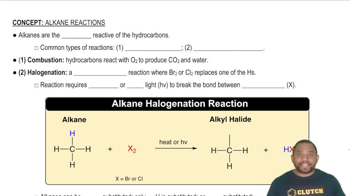
Common Types of Alkane Reactions Concept 1

Balanced Chemical Equation

A balanced chemical equation represents a chemical reaction with equal numbers of each type of atom on both sides of the equation. Balancing ensures the law of conservation of mass is upheld, meaning that matter is neither created nor destroyed in the reaction. This is crucial for accurately depicting the stoichiometry of the reaction.
Recommended video:
Guided course
01:32
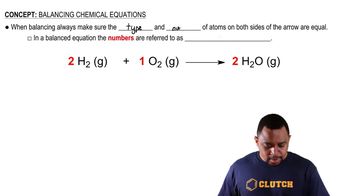
Balancing Chemical Equations (Simplified) Concept 1

Cyclopropane

Cyclopropane is a three-carbon cyclic alkane with the molecular formula C3H6. It is a flammable gas at room temperature and is used as a fuel and in organic synthesis. Understanding its structure and reactivity is essential for writing its combustion equation, as it determines the products formed during the reaction.