Pearson+ LogoPearson+ Logo
Ch.11 Introduction to Organic Chemistry: Hydrocarbons
Timberlake - Chemistry: An Introduction to General, Organic, and Biological Chemistry 13th Edition
Timberlake13th EditionChemistry: An Introduction to General, Organic, and Biological ChemistryISBN: 9780134421353Not the one you use?Change textbook
Chapter 11, Problem 4c

Identify each of the following properties as more typical of an organic or inorganic compound:
c. contains covalent bonds

Verified step by step guidance
1
Step 1: Understand the difference between organic and inorganic compounds. Organic compounds primarily contain carbon atoms bonded to hydrogen, oxygen, nitrogen, or other elements, and they often form covalent bonds. Inorganic compounds, on the other hand, may or may not contain carbon and are more likely to form ionic bonds.
Step 2: Recall the definition of covalent bonds. A covalent bond is a type of chemical bond where two atoms share electrons to achieve a stable electron configuration.
Step 3: Recognize that covalent bonding is a hallmark of organic compounds. Organic compounds, such as hydrocarbons, alcohols, and sugars, are predominantly composed of covalent bonds.
Step 4: Note that while some inorganic compounds can also contain covalent bonds (e.g., water, carbon dioxide), the presence of covalent bonds is more typical of organic compounds.
Step 5: Conclude that the property of 'contains covalent bonds' is more typical of organic compounds, based on the prevalence of covalent bonding in their molecular structures.

Verified video answer for a similar problem:

This video solution was recommended by our tutors as helpful for the problem above.
Was this helpful?

Key Concepts

Here are the essential concepts you must grasp in order to answer the question correctly.

Covalent Bonds

Covalent bonds are a type of chemical bond where two atoms share one or more pairs of electrons. This sharing allows each atom to attain the electron configuration of a noble gas, leading to greater stability. Covalent bonding is a hallmark of organic compounds, which often consist of carbon atoms bonded to other elements through these shared electron pairs.
Recommended video:
Guided course
01:04
Covalent Bonds Example 1

Organic Compounds

Organic compounds are primarily composed of carbon atoms and typically contain hydrogen, oxygen, nitrogen, and other elements. They are characterized by the presence of covalent bonds and functional groups that determine their chemical properties and reactivity. Examples include hydrocarbons, alcohols, and acids, which are essential in biological processes and industrial applications.
Recommended video:
Guided course
2:26
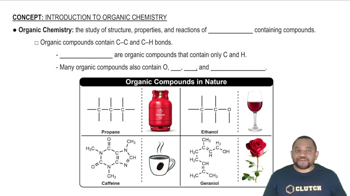
Introduction to Organic Chemistry Concept 1

Inorganic Compounds

Inorganic compounds generally do not contain carbon-hydrogen (C-H) bonds and include a wide range of substances such as salts, minerals, and metals. They can be ionic or covalent but are more commonly associated with ionic bonding, where electrons are transferred between atoms. Examples include sodium chloride and water, which play crucial roles in various chemical and biological systems.
Recommended video:
Guided course
02:11
Naming Ionic Compounds