Pearson+ LogoPearson+ Logo
Ch.4 Introduction to Organic Compounds
Frost - General, Organic and Biological Chemistry 4th Edition
Frost4th EditionGeneral, Organic and Biological ChemistryISBN: 9780134988696Not the one you use?Change textbook
Chapter 1, Problem 71d

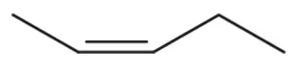
For each of the following compounds, indicate whether or not it can exist as cis–trans stereoisomers. If it can exist as the two isomers, draw both as a condensed structure.
(d)

Verified step by step guidance
1
Identify the structural requirements for a compound to exhibit cis-trans stereoisomerism. Cis-trans isomerism occurs in compounds with restricted rotation (e.g., double bonds or cyclic structures) and two different groups attached to each carbon of the double bond or ring.
Examine the given compound (represented by the placeholder) to determine if it contains a double bond or a ring structure that restricts rotation.
Check the substituents attached to the carbons of the double bond or the ring. Ensure that each carbon involved in the restricted rotation has two different groups attached to it. If this condition is not met, cis-trans isomerism is not possible.
If the compound meets the criteria for cis-trans isomerism, draw the two possible isomers. The 'cis' isomer will have the same groups on the same side of the double bond or ring, while the 'trans' isomer will have the same groups on opposite sides.
Label the structures clearly as 'cis' and 'trans' to distinguish between the two isomers. If the compound does not meet the criteria for cis-trans isomerism, state that it cannot exist as cis-trans isomers.

Verified video answer for a similar problem:

This video solution was recommended by our tutors as helpful for the problem above.
Video duration:
3m
Was this helpful?

Key Concepts

Here are the essential concepts you must grasp in order to answer the question correctly.

Cis-Trans Isomerism

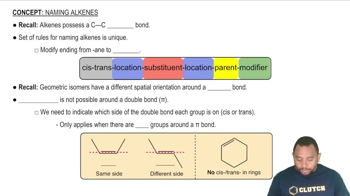
Cis-trans isomerism, also known as geometric isomerism, occurs in compounds with restricted rotation around a bond, typically a double bond. In cis isomers, substituents are on the same side of the double bond, while in trans isomers, they are on opposite sides. This type of isomerism is significant in determining the physical and chemical properties of compounds.
Recommended video:
Guided course
2:47
Rules for Naming Alkenes Concept 1

Criteria for Cis-Trans Isomerism

For a compound to exhibit cis-trans isomerism, it must have at least one double bond and two different substituents attached to each carbon of the double bond. If the substituents are identical on one carbon, the compound cannot have cis-trans isomers. Understanding these criteria is essential for identifying whether a given compound can exist in both forms.
Recommended video:
Guided course
2:47
Rules for Naming Alkenes Concept 1

Condensed Structural Formula

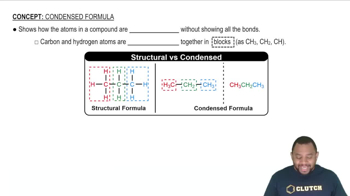
A condensed structural formula is a way of representing a chemical structure that shows the arrangement of atoms in a molecule without depicting all the bonds explicitly. It provides a simplified view of the molecule, indicating how atoms are connected. Drawing condensed structures for cis and trans isomers helps visualize the differences in their spatial arrangements.
Recommended video:
Guided course
1:53
Condensed Formula Concept 1