Ch.12 Food as Fuel An Overview of Metabolism
Frost - General, Organic and Biological Chemistry 4th Edition
Frost4th EditionGeneral, Organic and Biological ChemistryISBN: 9780134988696Not the one you use?Change textbook
Chapter 8, Problem 80c

Refer to the diagram of the citric acid cycle in Figure 12.11 to answer each of the following:
c. Name the reaction that is coupled to GTP formation.

Verified step by step guidance
1
Identify the step in the citric acid cycle where GTP (or ATP, depending on the organism) is formed. This occurs during the conversion of succinyl-CoA to succinate.
Understand that this reaction is catalyzed by the enzyme succinyl-CoA synthetase (also known as succinate thiokinase).
Recognize that the reaction involves substrate-level phosphorylation, where a high-energy thioester bond in succinyl-CoA is used to drive the formation of GTP (or ATP).
Note that the reaction can be summarized as: succinyl-CoA+GDP+Pisuccinate+GTP+CoA-SH.
Conclude that the reaction coupled to GTP formation is the conversion of succinyl-CoA to succinate, which is an example of substrate-level phosphorylation.

Verified video answer for a similar problem:

This video solution was recommended by our tutors as helpful for the problem above.
Video duration:
3m
Was this helpful?

Key Concepts

Here are the essential concepts you must grasp in order to answer the question correctly.

Citric Acid Cycle

The citric acid cycle, also known as the Krebs cycle, is a series of chemical reactions used by all aerobic organisms to generate energy. It takes place in the mitochondria and involves the oxidation of acetyl-CoA to produce ATP, NADH, and FADH2, which are crucial for cellular respiration.
Recommended video:
Guided course
2:31
Citric Acid Cycle Summary Concept 12

GTP Formation

GTP (guanosine triphosphate) formation occurs during the citric acid cycle, specifically in the conversion of succinyl-CoA to succinate. This reaction is catalyzed by the enzyme succinyl-CoA synthetase and is an example of substrate-level phosphorylation, where a phosphate group is directly transferred to GDP to form GTP.
Recommended video:
Guided course
1:41
Amide Formation Concept 1

Coupled Reactions

Coupled reactions involve linking an energetically unfavorable reaction with a favorable one to drive the overall process. In the context of the citric acid cycle, the reaction that produces GTP is coupled with the hydrolysis of the thioester bond in succinyl-CoA, which releases energy and makes the formation of GTP thermodynamically favorable.
Recommended video:
Guided course
1:46
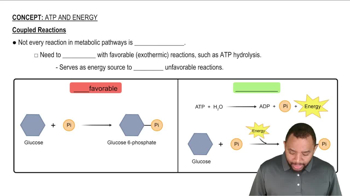
Coupled Reactions Concept 3