
Ch.12 Food as Fuel An Overview of Metabolism
Frost - General, Organic and Biological Chemistry 4th Edition
Frost4th EditionGeneral, Organic and Biological ChemistryISBN: 9780134988696Not the one you use?Change textbook
Chapter 8, Problem 81

If there are no reactions in the citric acid cycle that use oxygen, O2, why does the cycle operate only in aerobic conditions?

Verified step by step guidance
1
Understand the citric acid cycle: The citric acid cycle (also known as the Krebs cycle) is a series of chemical reactions that generate high-energy electron carriers (NADH and FADH₂) by oxidizing acetyl-CoA. These carriers are crucial for energy production in cells.
Recognize the role of oxygen in cellular respiration: While oxygen is not directly involved in the reactions of the citric acid cycle, it is essential for the electron transport chain (ETC), which occurs after the cycle. The ETC uses NADH and FADH₂ to produce ATP and requires oxygen as the final electron acceptor.
Connect the citric acid cycle to the electron transport chain: The citric acid cycle operates to supply NADH and FADH₂ to the ETC. Without oxygen, the ETC cannot function, leading to a buildup of NADH and FADH₂, which inhibits the citric acid cycle because these carriers cannot be regenerated into their oxidized forms (NAD⁺ and FAD).
Explain the dependency on aerobic conditions: In the absence of oxygen, the ETC halts, and the cell switches to anaerobic processes like fermentation to regenerate NAD⁺. These processes do not involve the citric acid cycle, which is why the cycle operates only in aerobic conditions.
Summarize the relationship: The citric acid cycle indirectly depends on oxygen because its products (NADH and FADH₂) are utilized in the oxygen-dependent electron transport chain. Without oxygen, the cycle cannot proceed efficiently.

Verified video answer for a similar problem:

This video solution was recommended by our tutors as helpful for the problem above.
Video duration:
4m
Was this helpful?

Key Concepts

Here are the essential concepts you must grasp in order to answer the question correctly.

Citric Acid Cycle

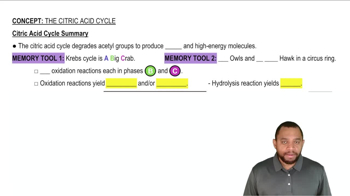
The citric acid cycle, also known as the Krebs cycle, is a series of enzymatic reactions that occur in the mitochondria, where acetyl-CoA is oxidized to produce energy carriers like NADH and FADH₂. Although it does not directly use oxygen, it is crucial for aerobic respiration as it generates the electron carriers that feed into the electron transport chain, which requires oxygen.
Recommended video:
Guided course
2:31
Citric Acid Cycle Summary Concept 12

Aerobic Respiration

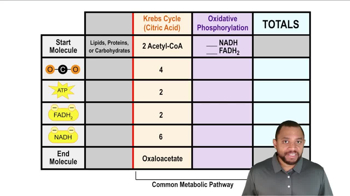
Aerobic respiration is a metabolic process that requires oxygen to produce energy. It involves the complete oxidation of glucose and other substrates, resulting in the production of ATP, carbon dioxide, and water. The citric acid cycle is a key component of this process, as it provides the necessary electron carriers for the electron transport chain, where the majority of ATP is generated in the presence of oxygen.
Recommended video:
Guided course
2:46
Aerobic Respiration Summary Concept 1

Electron Transport Chain

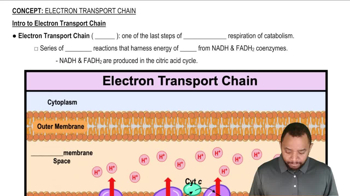
The electron transport chain (ETC) is a series of protein complexes located in the inner mitochondrial membrane that transfer electrons derived from NADH and FADH₂. This process creates a proton gradient that drives ATP synthesis through oxidative phosphorylation. Oxygen serves as the final electron acceptor in the ETC, making it essential for the continuation of the citric acid cycle and overall aerobic metabolism.
Recommended video:
Guided course
3:10
Intro to Electron Transport Chain Concept 1