Pearson+ LogoPearson+ Logo
Ch.10 Proteins Workers of the Cell
Frost - General, Organic and Biological Chemistry 4th Edition
Frost4th EditionGeneral, Organic and Biological ChemistryISBN: 9780134988696Not the one you use?Change textbook
Chapter 6, Problem 35b

Identify each of the following statements as characteristic of protein denaturation or protein hydrolysis. 
b. A protein breaks up into amino acid fragments.

Verified step by step guidance
1
Understand the two processes: Protein denaturation refers to the disruption of a protein's secondary, tertiary, or quaternary structure without breaking peptide bonds, while protein hydrolysis involves breaking the peptide bonds, resulting in smaller fragments or individual amino acids.
Analyze the statement: 'A protein breaks up into amino acid fragments.' This indicates that the protein is being broken down into its building blocks, which are amino acids.
Recognize that breaking peptide bonds is a characteristic of protein hydrolysis, as this process cleaves the bonds between amino acids in the protein chain.
Conclude that the statement describes protein hydrolysis because it explicitly mentions the breakdown of the protein into amino acid fragments.
Remember that protein denaturation does not involve breaking peptide bonds but rather the unfolding or structural alteration of the protein.

Verified video answer for a similar problem:

This video solution was recommended by our tutors as helpful for the problem above.
Video duration:
37s
Was this helpful?

Key Concepts

Here are the essential concepts you must grasp in order to answer the question correctly.

Protein Denaturation

Protein denaturation refers to the process where a protein loses its native structure due to external factors such as heat, pH changes, or chemical agents. This alteration affects the protein's functionality but does not break the peptide bonds between amino acids. Denatured proteins may aggregate or unfold, leading to loss of biological activity.
Recommended video:
Guided course
1:17
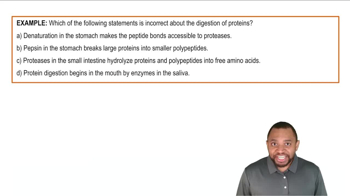
Digestion of Proteins Example 1

Protein Hydrolysis

Protein hydrolysis is a biochemical process where proteins are broken down into smaller peptides or amino acids through the addition of water. This reaction is typically catalyzed by enzymes or acids and involves the cleavage of peptide bonds. Hydrolysis is essential for digestion and the recycling of amino acids in the body.
Recommended video:
Guided course
1:12
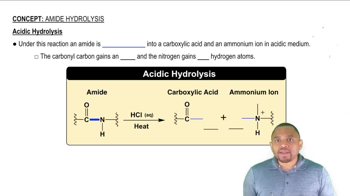
Acidic Hydrolysis Concept 1

Peptide Bonds

Peptide bonds are the covalent bonds that link amino acids together to form proteins. These bonds are formed through a dehydration synthesis reaction, where a molecule of water is released. Understanding peptide bonds is crucial for distinguishing between processes like denaturation, which does not break these bonds, and hydrolysis, which specifically targets and cleaves them.
Recommended video:
Guided course
1:24
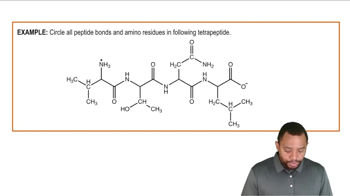
Peptides Example 1