Pearson+ LogoPearson+ Logo
Ch.10 Proteins Workers of the Cell
Frost - General, Organic and Biological Chemistry 4th Edition
Frost4th EditionGeneral, Organic and Biological ChemistryISBN: 9780134988696Not the one you use?Change textbook
Chapter 6, Problem 27b

What type of interaction would you expect between the side chains of each of the following pairs of amino acids in the tertiary structure of a protein?
b. leucine and isoleucine

Verified step by step guidance
1
Identify the side chains of leucine and isoleucine. Both are nonpolar and hydrophobic.
Understand that nonpolar side chains tend to interact through hydrophobic interactions.
In the tertiary structure of a protein, hydrophobic side chains like those of leucine and isoleucine will likely cluster together to avoid water.
These interactions help stabilize the protein's structure by minimizing the exposure of hydrophobic side chains to the aqueous environment.
Conclude that the interaction between leucine and isoleucine side chains is primarily hydrophobic in nature.

Verified video answer for a similar problem:

This video solution was recommended by our tutors as helpful for the problem above.
Video duration:
3m
Was this helpful?

Key Concepts

Here are the essential concepts you must grasp in order to answer the question correctly.

Amino Acid Side Chains

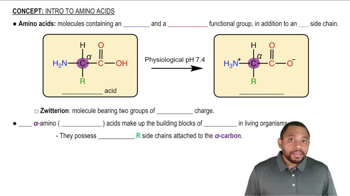
Amino acids have unique side chains (R groups) that determine their chemical properties and interactions. These side chains can be polar, nonpolar, acidic, or basic, influencing how amino acids interact with each other in a protein's tertiary structure. Understanding the nature of these side chains is crucial for predicting interactions between specific amino acids.
Recommended video:
Guided course
3:04
Intro to Amino Acids Concept 1

Hydrophobic Interactions

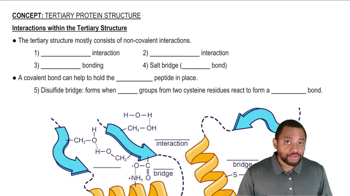
Hydrophobic interactions occur when nonpolar side chains, such as those of leucine and isoleucine, cluster together to avoid contact with water. This phenomenon is a key driving force in the folding of proteins, as it helps stabilize the tertiary structure by minimizing the exposure of hydrophobic regions to the aqueous environment.
Recommended video:
Guided course
2:41
Interactions within the Tertiary Structure Concept 2

Protein Tertiary Structure

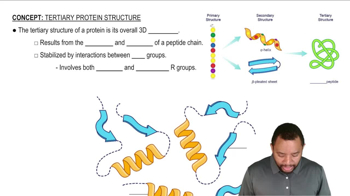
The tertiary structure of a protein refers to its three-dimensional shape formed by the folding of its polypeptide chain. This structure is stabilized by various interactions, including hydrophobic interactions, hydrogen bonds, ionic bonds, and disulfide bridges. The specific arrangement of amino acids, including leucine and isoleucine, plays a significant role in determining the overall stability and functionality of the protein.
Recommended video:
Guided course
2:07
Tertiary Protein Structure Concept 1