Explain why the properties of boron differ so markedly from the properties of the other group 3A elements.
Ch.22 - The Main Group Elements
Chapter 22, Problem 22.94
Which of the group 4A elements have allotropes with the diamond structure? Which have metallic allotropes? How does the variation in the structure of the group 4A elements illustrate how metallic character varies down a periodic group?
Verified step by step guidance1
Identify the elements in group 4A of the periodic table: carbon (C), silicon (Si), germanium (Ge), tin (Sn), and lead (Pb).
Recognize that carbon has an allotrope with a diamond structure, which is a network covalent structure.
Understand that silicon and germanium also form diamond-like structures, but they are not as hard as carbon's diamond.
Note that tin and lead have metallic allotropes, with tin having both metallic (white tin) and non-metallic (gray tin) forms.
Explain that as you move down group 4A, the elements transition from non-metallic (carbon) to more metallic character (lead), illustrating the increase in metallic character down the group.

Verified video answer for a similar problem:
This video solution was recommended by our tutors as helpful for the problem above.
Was this helpful?
Key Concepts
Here are the essential concepts you must grasp in order to answer the question correctly.
Allotropes
Allotropes are different forms of the same element, where atoms are bonded together in different ways. For example, carbon has several allotropes, including diamond and graphite, which exhibit distinct physical properties due to their unique atomic arrangements. Understanding allotropy is crucial for identifying which group 4A elements can form structures like diamond.
Metallic Character
Metallic character refers to the tendency of an element to exhibit properties typical of metals, such as conductivity, malleability, and luster. In the periodic table, metallic character generally increases as you move down a group due to the increasing atomic size and decreasing ionization energy, which allows for easier electron loss. This concept is essential for analyzing how the structure of group 4A elements influences their metallic properties.
Recommended video:
Guided course
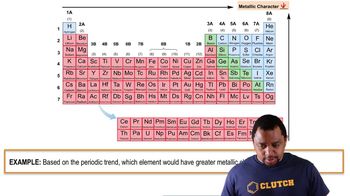
Metallic Character Example
Group 4A Elements
Group 4A elements, also known as group 14 in the periodic table, include carbon (C), silicon (Si), germanium (Ge), tin (Sn), and lead (Pb). These elements exhibit a range of allotropes and bonding characteristics, from nonmetals like carbon to metals like lead. Understanding the properties and structures of these elements helps explain the variation in their allotropes and metallic character.
Recommended video:
Guided course
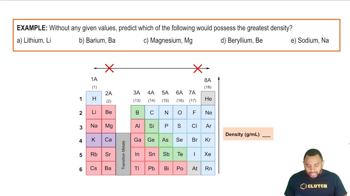
Main Group Elements: Density Example
Related Practice
Textbook Question
2
views
Textbook Question
Describe the structures of the white and red allotropes of phosphorus, and explain why white phosphorus is so reactive.
Textbook Question
Compare some of the physical properties of H2S, NaH, and PdHx.
Textbook Question
GeCl4 reacts with Cl- to give GeCl62-, but CCl4 does not react with excess Cl-. Explain.
Textbook Question
Using the shorthand notation of Figure 22.9, draw the structure of the cyclic silicate anion in which four SiO4 tetrahedra share O atoms to form an eight-membered ring of alternating Si and O atoms. Give the formula and charge of the anion.
Textbook Question
Which of the following elements (X) will form a covalent hydride with the formula XH3 that is a gas at room temperature? (LO 22.4)
(a) Al (b) As (c) Ba (d) Se