First, recall that the derivative of y = csc(x) is y' = -csc(x)cot(x). This is a standard derivative that you can find in derivative tables or by using the chain rule and trigonometric identities.
Next, to find the second derivative y'', we need to differentiate y' = -csc(x)cot(x) with respect to x. This requires using the product rule, which states that if you have a function u(x)v(x), its derivative is u'(x)v(x) + u(x)v'(x).
Apply the product rule to y' = -csc(x)cot(x). Let u(x) = -csc(x) and v(x) = cot(x). Then, u'(x) = csc(x)cot(x) and v'(x) = -csc^2(x).
Substitute these derivatives into the product rule formula: y'' = u'(x)v(x) + u(x)v'(x) = [csc(x)cot(x)]cot(x) + [-csc(x)][-csc^2(x)].
Simplify the expression: y'' = csc(x)cot^2(x) + csc^3(x). This is the second derivative of y = csc(x).
Verified video answer for a similar problem:
This video solution was recommended by our tutors as helpful for the problem above
Video duration:
4m
Play a video:
Was this helpful?
Key Concepts
Here are the essential concepts you must grasp in order to answer the question correctly.
Second Derivative
The second derivative, denoted as y'', measures the rate of change of the first derivative of a function. It provides information about the concavity of the function and can indicate points of inflection where the function changes from concave up to concave down or vice versa.
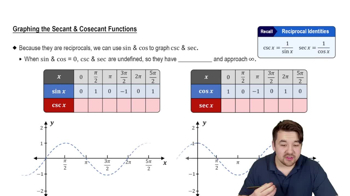
The cosecant function, denoted as csc x, is the reciprocal of the sine function, defined as csc x = 1/sin x. It is important to understand its properties, including its domain and range, as well as its behavior near asymptotes where sin x equals zero.
Differentiation rules, such as the quotient rule and chain rule, are essential for finding derivatives of complex functions. For the cosecant function, applying the quotient rule is necessary since it can be expressed as a ratio, which simplifies the process of finding its first and second derivatives.