
Pearson+ LogoPearson+ Logo
Ch. 6 - Lipids, Membranes, and the First Cells
Freeman - Biological Science 8th Edition
Freeman8th EditionBiological ScienceISBN: 9780138276263Not the one you use?Change textbook
Chapter 6, Problem 3

What two conditions must be present for osmosis to occur? Integral membrane proteins are anchored in lipid bilayers.

Verified step by step guidance
1
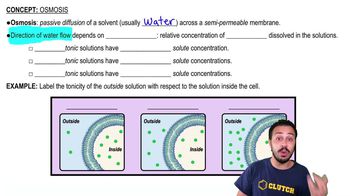
Understand the concept of osmosis: Osmosis is the movement of water molecules across a semipermeable membrane from an area of lower solute concentration to an area of higher solute concentration.
Identify the first condition for osmosis: There must be a semipermeable membrane that allows the passage of water molecules but restricts the movement of solute molecules.
Identify the second condition for osmosis: There must be a concentration gradient of solute across the membrane, meaning there is a difference in solute concentration on either side of the membrane.
Recognize the role of integral membrane proteins: These proteins are embedded within the lipid bilayer and can facilitate the transport of molecules across the membrane, but they are not directly involved in osmosis.
Clarify the anchoring of integral membrane proteins: Integral membrane proteins are anchored in lipid bilayers through hydrophobic interactions between the protein and the lipid molecules, ensuring their stability and function within the membrane.

Verified video answer for a similar problem:

This video solution was recommended by our tutors as helpful for the problem above.
Video duration:
1m
Was this helpful?

Key Concepts

Here are the essential concepts you must grasp in order to answer the question correctly.

Osmosis

Osmosis is the passive movement of water molecules across a semipermeable membrane from a region of lower solute concentration to a region of higher solute concentration. This process aims to equalize solute concentrations on both sides of the membrane, and it is crucial for maintaining cellular homeostasis.
Recommended video:

Semipermeable Membrane

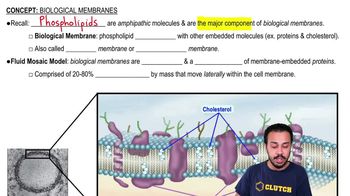
A semipermeable membrane is a barrier that allows certain molecules or ions to pass through it while blocking others. In the context of osmosis, it permits the passage of water molecules but restricts solute movement, creating the conditions necessary for osmosis to occur.
Recommended video:
Guided course
06:04
Biological Membranes

Concentration Gradient

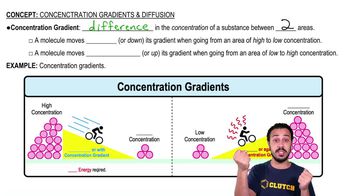
A concentration gradient refers to the difference in the concentration of a solute across a space or a membrane. For osmosis to occur, there must be a concentration gradient of solutes across the semipermeable membrane, driving the movement of water to balance solute concentrations.
Recommended video:
Guided course
04:51
Concentration Gradients and Diffusion