
Textbook Question
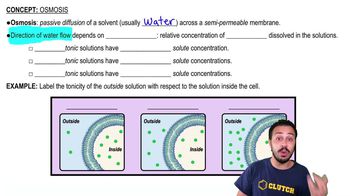
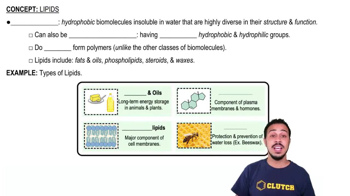
In terms of structure, how do channel proteins differ from carrier proteins?




 Verified step by step guidance
 05:59
05:59
 04:19
04:19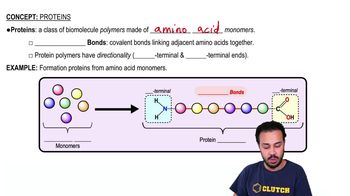 02:50
02:50In terms of structure, how do channel proteins differ from carrier proteins?
Suppose a cell is placed in a solution with a high concentration of potassium and no sodium. How would the cellular sodium–potassium pump function in this environment?
a. It would stop moving ions across the membrane.
b. It would continue using ATP to pump sodium out of the cell and potassium into the cell.
c. It would move sodium and potassium ions across the membrane, but no ATP would be used.
d. It would reverse the direction of sodium and potassium ions to move them against their gradients.
In an experiment, you create two groups of liposomes in a solution containing 0.1 M NaCl—one made from red blood cell membranes and the other from frog egg cell membranes. When the liposomes are placed in water, those with red blood cell membranes burst more rapidly than those made from egg membranes. What could explain these results? Select True or False for each of the following statements.
a. T/F The red blood cell liposomes are more hypertonic relative to water than the frog egg liposomes.
b. T/F The red blood cell liposomes are more hypotonic relative to water than the frog egg liposomes.
c. T/F The red blood cell liposomes contain more aquaporins than the frog egg liposomes.
d. T/F The frog egg liposomes contain ion channels, which are not present in the red blood cell liposomes.