
Pearson+ LogoPearson+ Logo
Ch. 54 - Biodiversity and Conservation Ecology
Freeman - Biological Science 8th Edition
Freeman8th EditionBiological ScienceISBN: 9780138276263Not the one you use?Change textbook
Chapter 54, Problem 11

Do you drink coffee? A lot of people do—coffee is a major tropical crop, valued at over \$100 billion per year. The most popular species of coffee, Coffea arabica, originated in Africa and is now planted extensively in Central and South America. The pest called the coffee berry borer beetle (Hypothenemus hampeii) moved along with the coffee and is a major problem for coffee farmers, sometimes destroying half of the coffee crop in mature plantations.
Based on what you have learned in this chapter about global trends in terrestrial ecosystems, what is currently the largest threat to the wet tropical forests in Central America?
a. Habitat destruction, such as the clearing of forests for coffee plantations
b. Exotic species, such as the introduction of coffee berry borers
c. Pollution, such as the use of pesticides in coffee plantations
d. Climate change, such as changes in precipitation patterns

Verified step by step guidance
1
Identify the context of the problem: The problem discusses the impact of coffee cultivation on wet tropical forests in Central America.
Consider the options provided: a) habitat destruction, b) exotic species, c) pollution, d) climate change.
Evaluate each option based on its potential impact on wet tropical forests: Habitat destruction involves clearing forests, which directly reduces forest area. Exotic species can disrupt local ecosystems. Pollution from pesticides can harm biodiversity. Climate change can alter precipitation patterns, affecting forest health.
Relate the options to global trends in terrestrial ecosystems: Habitat destruction is a significant global issue, often leading to loss of biodiversity and ecosystem services.
Determine which option aligns most closely with the largest threat to wet tropical forests, considering the context of coffee cultivation and its environmental impacts.

Verified video answer for a similar problem:

This video solution was recommended by our tutors as helpful for the problem above.
Video duration:
1m
Was this helpful?

Key Concepts

Here are the essential concepts you must grasp in order to answer the question correctly.

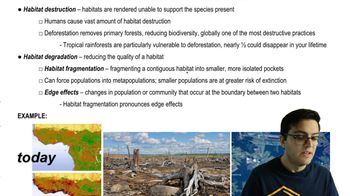
Habitat Destruction

Habitat destruction refers to the process by which natural habitats are altered or eliminated, often due to human activities such as agriculture, urbanization, and deforestation. In the context of coffee plantations, clearing forests to make way for coffee crops can lead to significant loss of biodiversity and disruption of ecosystems, posing a major threat to wet tropical forests in Central America.
Recommended video:
Guided course
03:23
Habitat Destruction and Degradation

Exotic Species

Exotic species, also known as invasive species, are organisms introduced to new environments where they are not native. These species can outcompete native species for resources, leading to ecological imbalance. The coffee berry borer beetle is an example of an exotic species that has become a pest in coffee-growing regions, causing substantial damage to crops and affecting local ecosystems.
Recommended video:
03:24
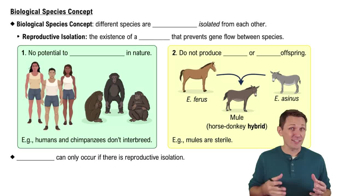
Biological Species Concept

Climate Change

Climate change involves long-term alterations in temperature, precipitation, and other atmospheric conditions. It can impact ecosystems by changing habitat conditions, affecting species distribution, and altering agricultural productivity. In Central America, shifts in precipitation patterns due to climate change can threaten wet tropical forests, influencing both biodiversity and the viability of coffee plantations.
Recommended video:
Guided course
03:36
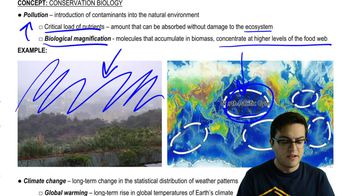
Pollution and Climate Change
Related Practice
Textbook Question

The population size of mountain pine beetles in the American Northwest has long been held in check by freezing temperatures during the winters. As winters warm, populations of pine beetles are increasing, killing whitebark pine forest. Grizzly bears rely on the nuts of whitebark pine trees. Do you think climate change is affecting the fitness of the grizzly bear population?


a. No, because climate change is affecting the beetles, not the bears.

b. Yes, because climate change is decreasing the food supply of the bears, which means they will be less strong.

c. Yes, because climate change is decreasing the food supply of the bears, which is likely to reduce their ability to survive or reproduce.

Textbook Question

The maps shown here chronicle the loss of old-growth forest (more than 200 years old) that occurred in the United States. In your opinion, under what conditions is it ethical for conservationists who live in the United States to lobby government officials in Brazil, Indonesia, and other tropical countries to slow the rate of loss of old-growth forest?

Textbook Question

Do you drink coffee? A lot of people do—coffee is a major tropical crop, valued at over \$100 billion per year. The most popular species of coffee, Coffea arabica, originated in Africa and is now planted extensively in Central and South America. The pest called the coffee berry borer beetle (Hypothenemus hampeii) moved along with the coffee and is a major problem for coffee farmers, sometimes destroying half of the coffee crop in mature plantations.

Pesticides are generally ineffective in killing coffee berry borers. Ecologist Daniel Karp and colleagues conducted a study in Costa Rica to determine if natural predators like birds reduce the beetle population. The researchers selected 12 control plots and used nets to exclude birds from 12 similar treatment plots. What is the take-home message of the graph? (Remember, * means P < 6 0.05)

Textbook Question

Do you drink coffee? A lot of people do—coffee is a major tropical crop, valued at over \$100 billion per year. The most popular species of coffee, Coffea arabica, originated in Africa and is now planted extensively in Central and South America. The pest called the coffee berry borer beetle (Hypothenemus hampeii) moved along with the coffee and is a major problem for coffee farmers, sometimes destroying half of the coffee crop in mature plantations.

Look at the graph. Why did the researchers bother to collect data from the coffee shrubs before adding the nets to treatment plots to exclude birds?

Textbook Question

Do you drink coffee? A lot of people do—coffee is a major tropical crop, valued at over \$100 billion per year. The most popular species of coffee, Coffea arabica, originated in Africa and is now planted extensively in Central and South America. The pest called the coffee berry borer beetle (Hypothenemus hampeii) moved along with the coffee and is a major problem for coffee farmers, sometimes destroying half of the coffee crop in mature plantations. The abundance of birds and other predators of borer beetles depends on how much natural forest is left within and around the coffee plantations. What is the approximate percentage increase in borer predators per hectare if forest cover is doubled from 15 to 30 percent?

1
views